
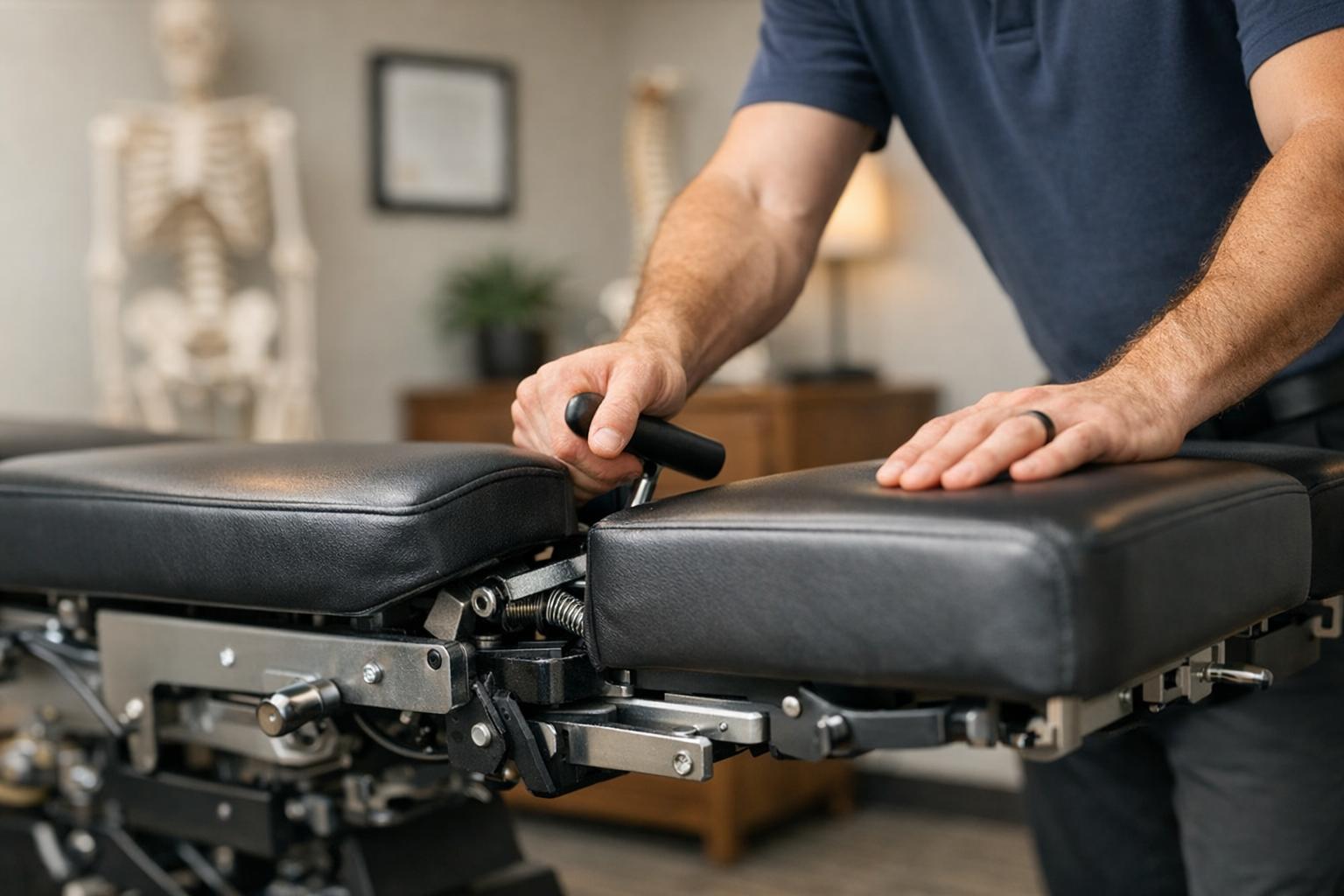
Drop table adjustment, also known as the Thompson Technique, is a chiropractic method that uses a specialized table with segments that drop slightly during spinal adjustments. This technique combines gravity and the patient’s body weight with a precise thrust from the chiropractor to realign the spine. It’s a gentler alternative to manual adjustments, making it suitable for people with conditions like sciatica, herniated discs, or osteoporosis.
Here’s how it works:
- The chiropractor identifies misalignments using a leg-length analysis.
- The table segment under the target area is raised slightly and calibrated to the patient’s weight.
- A quick, controlled thrust is applied, causing the segment to drop and guide the spine into alignment.
Key benefits include reduced force during adjustments, improved comfort, and suitability for sensitive patients like children, older adults, and pregnant women. It’s also safer for chiropractors, as it minimizes physical strain.
If you’re looking for a gentler chiropractic option, drop table adjustments provide precise, effective spinal care with minimal discomfort.
How Drop Table Adjustments Work
The Drop Table Mechanism
A drop table is carefully designed to target specific areas of the spine, with separate segments for the cervical (neck), thoracic (mid-back), lumbar (lower back), and pelvic regions. Each segment functions independently, allowing chiropractors to isolate and adjust one area without affecting the others.
Before performing an adjustment, the chiropractor raises the appropriate table segment by 0.75 to 2 inches using a foot pedal or hand lever. A tension mechanism locks the segment in place, calibrated to the patient’s body weight. This calibration is crucial – too much tension prevents the segment from dropping, while too little tension reduces the precision of the adjustment.
When the chiropractor applies a High-Velocity, Low-Amplitude (HVLA) thrust, the force overcomes the tension, causing the segment to drop a small distance before stopping abruptly. This quick motion happens faster than the patient’s muscles can react, minimizing resistance. Taking advantage of Newton’s First Law of Motion, the patient’s momentum continues slightly after the table stops, guiding the joint through its intended range of motion with minimal force. The distinct “thud” sound during the adjustment comes from the table mechanism itself, not the patient’s joints.
“The drop piece is then lifted, and a manual chiropractic adjustment is delivered to the patient so that the drop piece releases and falls back to its neutral position. Once the drop piece comes to a rest, the momentum gathered from the drop continues through the patient for a very short period of time.” – Dr. Derek DeCagna, Chiropractor, Core Therapies
This rapid drop also stimulates mechanoreceptors – nerve endings that detect movement and pressure – acting as a “pattern interrupt.” This helps reset muscle tone and reduces pain signals, creating the foundation for an effective adjustment.
The Adjustment Process Step-by-Step
Using the drop table’s mechanics, chiropractors follow a structured approach to ensure precision and comfort during adjustments. The process begins with a leg length analysis, which helps identify spinal or pelvic imbalances as the patient lies face down. After pinpointing the problem area, the patient is positioned so the target region aligns with the corresponding drop segment.
The chiropractor then raises the specific table segment and adjusts the tension mechanism to match the patient’s body weight. This ensures the segment will drop precisely when the thrust is applied, while keeping the patient in a relaxed, neutral position – no twisting or turning required.
Finally, the chiropractor delivers a controlled thrust that releases the tension and activates the drop.
| Step | Action | Purpose |
|---|---|---|
| 1. Analysis | Leg length check and palpation | Identify spinal or pelvic misalignments |
| 2. Setup | Elevate the table segment (0.75–2 inches) | Prepare for the gravitational assist |
| 3. Calibration | Adjust the tension mechanism | Ensure the drop aligns with the patient’s weight |
| 4. Application | Deliver a precise thrust | Trigger the controlled drop |
| 5. Completion | Table returns to neutral | Momentum aids in joint realignment |
“The drop allows gravity to assist and work in combination with the manual adjustment, and all of this provides a lighter adjustment than that which comes with some other chiropractic techniques.” – Advanced Care Back & Body
This step-by-step method ensures a smooth, effective adjustment while minimizing discomfort for the patient.
Benefits and Uses of Drop Table Adjustments
Patient Benefits
Drop table adjustments offer a practical solution for managing chronic pain and improving mobility. According to clinical data, patient-reported success rates are impressive: 90% for chronic back pain, 85% for sciatica, 80% for neck pain, and 75% for herniated discs. A decade-long study covering 50,000 treatments found zero major complications and a 99% satisfaction rate among patients.
What sets this method apart is its gentler approach. Unlike traditional manual adjustments that involve twisting or forceful movements, drop table adjustments allow patients to stay in a relaxed, neutral position while gravity assists the process. Studies show that this technique reduces the force needed for adjustments by up to 30% compared to manual methods. This makes it especially suitable for sensitive groups like children, older adults, pregnant women, and individuals with conditions such as osteoporosis or acute injuries.
“Drop table adjustments are experienced as a ‘gentler’ form of spinal manipulation because they require less power from the practitioner and less ancillary movement and/or special positioning by the patient.” – Dr. Derek DeCagna, Chiropractor, Core Therapies
Clinical studies also highlight a 99.9% safety rate for this technique, with minimal soreness or discomfort reported during and after treatment.
Applications in Healthcare
Drop table adjustments are widely used to address various spinal and musculoskeletal issues. Chiropractors frequently rely on this technique to treat conditions such as herniated discs, degenerative disc disease, scoliosis, spondylolisthesis, and sacroiliac (SI) joint dysfunction. Research shows that SI joint problems contribute to up to 15% of back pain cases and may account for as much as 70% of postsurgical fusion failures.
Beyond alleviating pain, this method supports nervous system health by realigning vertebrae and reducing pressure on spinal nerves. This enhanced alignment encourages natural healing and supports overall well-being. At HML Chiropractic & Functional Care, drop table adjustments are part of a broader care strategy. They are used to complement treatments for conditions such as ADHD, autism, learning disabilities, and traumatic brain injuries, where improving nervous system function is critical for better outcomes. The precision of segmental drops also allows practitioners to focus on specific areas, like the lumbar-sacral junction, making the technique effective for both acute injuries and long-term health challenges.
Drop Table Adjustments vs. Manual Techniques
Both drop table and manual adjustments aim to address spinal misalignments, but they differ in how force is applied and how patients are positioned during treatment. Manual adjustments rely heavily on the chiropractor’s physical strength and leverage, often requiring patients to twist or lie on their side to achieve the necessary angle for treatment. On the other hand, drop table adjustments utilize gravitational force to assist the process, reducing the need for direct manual effort. Unlike manual techniques, which depend entirely on the chiropractor’s leverage, drop table adjustments integrate mechanical assistance to enhance precision and effectiveness.
Drop table adjustments employ high-velocity, low-amplitude (HVLA) thrusts that focus on speed rather than sheer force. The table’s controlled drop – usually between 1 and 2 inches – amplifies the adjustment’s impact with minimal physical exertion from the chiropractor. This approach not only enhances the adjustment’s efficiency but also helps reduce the physical strain on practitioners, lowering their risk of repetitive stress injuries. This distinction highlights the fundamental differences between these two techniques.
“Drop Table (Thompson) Technique utilizes gravity and the patient’s own weight to make an impactful influence on the force of a chiropractic adjustment.“– Dr. Derek DeCagna, Chiropractor, Core Therapies
Patient positioning is another key difference. Manual techniques often require awkward body positions, such as twisting or lying on the side, to create the proper leverage for adjustments. In contrast, drop table adjustments allow patients to stay in a neutral prone (face-down) or supine (face-up) position, which helps reduce spinal stress and minimizes muscle tension during treatment. The segmented design of drop tables also enables chiropractors to perform highly targeted, localized adjustments. The widespread adoption of this method underscores its effectiveness.
Comparison Table: Drop Table vs. Manual Adjustments
The table below outlines the main differences between these two chiropractic techniques.
| Feature | Manual Adjustments | Drop Table Adjustments |
|---|---|---|
| Primary Force | A chiropractor’s physical strength and leverage | Gravity and inertia are assisted by a mechanical drop |
| Patient Positioning | Requires twisting or side-lying positioning | Neutral prone or supine (face-down/up) |
| Audible Sound | Produces a “pop” or “crack” (cavitation) | Characterized by a muffled “thud” from the table |
| Force Intensity | Higher force required for effective manipulation | Lower force; the table’s drop completes the motion |
| Ideal Candidates | General population with standard mobility | Geriatric, pediatric, acute pain, or anxious patients |
| Clinical Focus | General spinal mobilization | Highly specific segmental corrections |
| Provider Ergonomics | More physically demanding for the chiropractor | Reduces practitioner fatigue and strain |
Conclusion
Drop table adjustments combine the principles of physics with clinical expertise, using gravity and the patient’s own weight to achieve spinal corrections with less force than traditional manual techniques. The controlled drop not only facilitates alignment but also triggers a neurological response that helps reset muscle tone and improve biomechanics.
Thanks to its precision, this method is especially suited for patients who may find traditional adjustments uncomfortable. Whether dealing with acute pain, recovering from an injury, or simply preferring a gentler approach, drop table adjustments allow for targeted treatment of specific vertebrae while keeping the patient in a relaxed, neutral position. This reduces physical strain and helps alleviate anxiety during the process.
“The drop table is a great equalizer… allowing a chiropractor of any size to adjust a patient of any size with the same degree of precision and effectiveness.” – Elite Chiropractic Tables
For those seeking expert chiropractic care, HML Chiropractic & Functional Care offers tailored treatments that incorporate advanced drop table techniques. Their state-of-the-art equipment ensures adjustments are both safe and effective, designed to meet your unique health needs – whether addressing chronic discomfort, developmental concerns, or overall wellness.
If you’re experiencing spinal discomfort, limited mobility, or are curious about a gentler chiropractic option, scheduling a comprehensive evaluation could be the first step. With professional guidance, you can receive care that’s precisely calibrated to your needs, delivered with the safety and effectiveness that modern drop table methods provide
FAQs
Does a drop table adjustment hurt?
A drop table adjustment is a chiropractic method that’s typically gentle and painless. It relies on low-force, low-speed movements, making it a comfortable and safe option for most people. The technique is crafted to reduce discomfort while effectively targeting alignment problems.
Who should avoid drop table adjustments?
People dealing with severe osteoporosis, spinal instability, or acute spinal fractures should steer clear of drop table adjustments. These conditions can heighten the chance of injury during this specific chiropractic technique.
How many drop table sessions will I need?
The frequency of drop table sessions depends on your individual condition and how severe it is. Many people find that their range of motion improves and pain decreases after each session. Your chiropractor will monitor your progress and create a treatment plan specifically designed for you.