Most people think of chiropractic care as something you do for a bad back. You’ve got pain, a chiropractor adjusts your spine, and the pain gets better. That’s a fair description of traditional chiropractic — and it genuinely helps a lot of people.
But at HML Functional Care in Lee’s Summit, MO, chiropractic care operates on a deeper premise: that the spine and the brain are not separate systems, and that restoring proper spinal function has measurable effects on how the nervous system — including the brain — works.
This is what brain-based chiropractic care means. And understanding it changes who chiropractic is for.
The Spine-Brain Connection
Your spine isn’t just a structural column that holds you upright. It’s a primary information highway between your body and your brain.
Every spinal joint contains mechanoreceptors — specialized sensory nerve endings that constantly send positional and movement information up to the brain. When spinal joints move freely and properly, they generate a rich stream of sensory input that the brain uses to regulate balance, coordinate movement, process sensory information, and maintain neurological tone throughout the body.
When spinal joints stop moving properly — a condition chiropractors call subluxation — this sensory input is disrupted. The brain receives less information from that region of the spine, which can affect neurological function in ways that extend well beyond local pain. Subluxation also triggers a stress response: the affected joints send distress signals to the brain, which responds by releasing cortisol systemically. This means a subluxated spine doesn’t just cause pain — it actively increases your body’s overall stress load.
Restoring proper joint motion through chiropractic adjustment does more than relieve pain. It restores the sensory input the brain depends on and reduces the neurological stress that subluxation creates.
How Brain-Based Chiropractic Differs from Conventional Chiropractic
Conventional chiropractic focuses primarily on pain relief and structural alignment. It’s symptom-targeted and highly effective for what it’s designed to do.
Brain-based chiropractic — the approach used at HML — takes a broader view. It starts by asking: which areas of the nervous system are underperforming, and how is spinal function contributing to that? The chiropractic adjustment is then selected and applied specifically to generate the neurological input that the brain needs, not just to relieve local pain.
This is why at HML, chiropractic care is integrated with functional neurology rather than practiced in isolation. The two approaches are deeply complementary: functional neurology identifies the specific neurological patterns that need to change, and chiropractic care is one of the tools used to create the sensory input that drives that change.
Brain Hemispheric Integration is a specific example of this at work. When one hemisphere of the brain is underperforming relative to the other, targeted adjustments and sensory stimulation can be directed at the side of the body that activates the weaker hemisphere — not just where there’s pain, but where the brain needs input.
Who Does Brain-Based Chiropractic Care Help
Because brain-based chiropractic addresses neurological function — not just structural pain — the range of people who benefit is broader than most expect.
Adults with chronic pain, back pain, neck pain, headaches, migraines, sciatica, and disc issues all respond well to chiropractic care. At HML, these conditions are also evaluated for their neurological component, because chronic pain often has a central sensitization dimension that purely structural treatment misses.
Children with neurodevelopmental conditions. This is one of the most important applications of brain-based chiropractic and one of HML’s core areas of expertise. Children with ADHD, autism, dyslexia, and learning disabilities, and childhood neurodevelopmental disorders often have compromised spinal sensory input contributing to the neurological patterns driving their symptoms. Gentle, targeted pediatric chiropractic care — combined with functional neurology — is a meaningful part of how HML addresses these conditions.
Concussion and TBI patients. After a traumatic brain injury, the relationship between spinal function and brain function becomes especially important. Cervical spine dysfunction is frequently observed after head trauma and is recognized as a contributing factor to post-concussion symptoms, including dizziness, headaches, and cognitive fog. Addressing the cervical spine through chiropractic care is a core component of HML’s post-concussion rehabilitation approach.
Patients with vertigo and dizziness, the cervical spine has a direct relationship with the vestibular system — the brain’s balance and spatial awareness network. Many cases of vertigo and dizziness have a cervicogenic component that responds well to chiropractic care combined with vestibular rehabilitation.
Athletes and active individuals HML explicitly supports athletes across age groups — from youth sports to adult performance. Tools like RightEye sports vision testing and Senaptec sensory evaluation are used specifically for athletic performance alongside chiropractic care. Brain-based chiropractic supports proprioception, reaction time, coordination, recovery, and neurological optimization for sports performance — not just structural alignment.
What a Brain-Based Chiropractic Visit Looks Like at HML
At HML, a chiropractic visit is part of a broader neurological care plan — not a standalone intervention. Before any adjustment is made, the doctors have conducted a comprehensive neurological and chiropractic evaluation to understand exactly which areas of the spine are subluxated, how those subluxations are affecting neurological function, and what type of adjustment is most appropriate.
Adjustments at HML are specific and targeted. Rather than a general full-spine adjustment, the approach is directed at the areas most relevant to the patient’s neurological needs at that visit. This specificity is what makes brain-based chiropractic more than conventional chiropractic — it’s the integration of neurological assessment into every clinical decision.
For children, adjustments are always adapted to their size, age, and comfort level. The techniques used for pediatric patients bear little resemblance to adult adjustments — they are gentle, precise, and typically very brief.
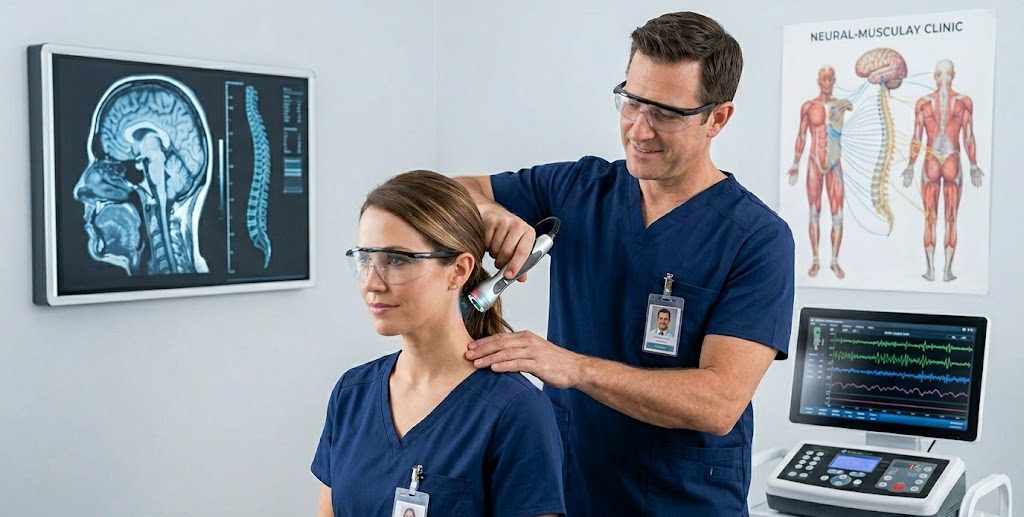
Depending on your care plan, your chiropractic visit may be combined in the same session with other functional neurology therapies — eye movement exercises, vestibular work, Interactive Metronome, or Cold Laser Therapy — creating a comprehensive neurological rehabilitation session rather than an isolated adjustment.
A Different Way to Think About Chiropractic
If you’ve always thought of chiropractic as something you do when your back hurts, brain-based chiropractic invites a different frame: it’s a way of delivering precise neurological input through the spine to help the brain function better.
Pain relief is often the most immediate and noticeable result. But for many patients — especially those being treated for neurodevelopmental conditions, post-concussion symptoms, or chronic neurological challenges — the broader effects on brain function are what matter most.
At HML Functional Care, chiropractic care doesn’t stand alone. It’s one carefully integrated piece of a whole-nervous-system approach to your health.
Learn more about Chiropractic Care at HML →
Schedule a consultation in Lee’s Summit →
HML Functional Care | 200 NE Missouri Rd #306, Lee’s Summit, MO 64086 | (816) 768-6000