
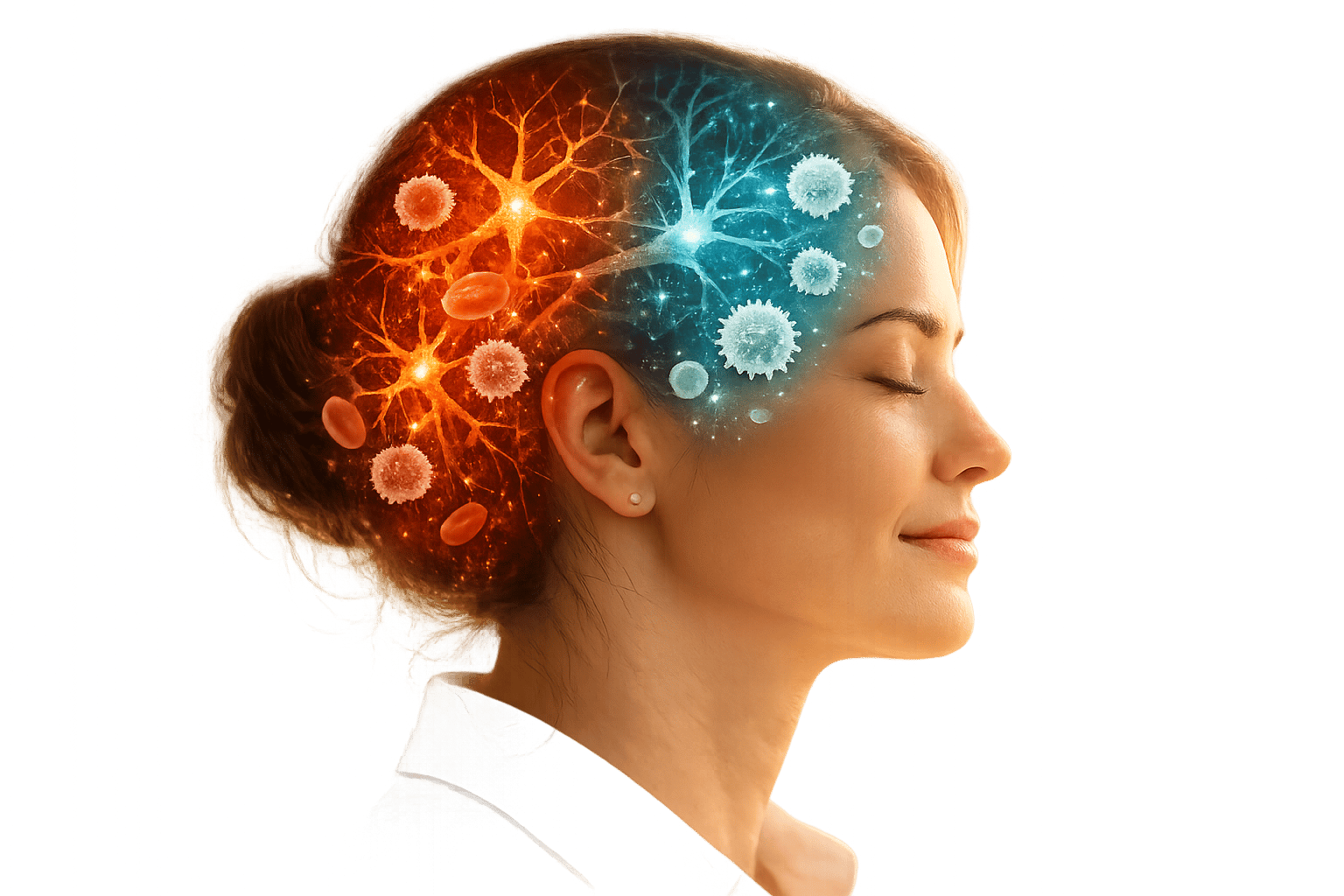
Stress is more than a feeling. When it becomes chronic, it triggers a measurable cascade of biological changes that affect your brain, your immune system, and your long-term health, often in ways that standard medicine misses entirely.
Short-term stress helps you respond to challenges. But when stress never fully turns off, the body’s protective mechanisms begin working against it. Inflammation rises, neurotransmitter balance shifts, and brain structure itself can change, contributing to conditions like depression, anxiety, cardiovascular disease, and autoimmune disorders.
Understanding the connection between stress and your neuroimmune system is the first step. Knowing that these imbalances can be identified and addressed with targeted, personalized care is where the real hope lies.
Key takeaways from this article:
- Chronic stress weakens the brain’s ability to regulate inflammation, leading to long-term damage.
- Inflammation alters neurotransmitter production, directly affecting mood and cognition.
- Stress physically reshapes the brain, shrinking areas linked to memory while enlarging areas linked to fear.
- About 25% of people with depression show signs of inflammation, which may explain why standard treatments often fail.
- Personalized functional care, including gut health, anti-inflammatory nutrition, food sensitivity testing, and functional neurology, can target the root causes.
How Chronic Stress Disrupts Neuroimmune Function
When stress persists over time, the body’s defense mechanisms can begin to fail. What starts as a protective response eventually shifts into harmful inflammation, playing a central role in many chronic conditions.
Stress-Triggered Inflammatory Pathways
Chronic stress activates the sympathetic nervous system, which releases hormones like norepinephrine and adrenaline. These hormones bind to immune cells, including monocytes and macrophages, triggering an inflammatory chain reaction through a key transcription factor called NF-κB. This drives up the production of pro-inflammatory cytokines like IL-1β, IL-6, and TNF-α.
These cytokines can cross into the brain through a temporarily weakened blood-brain barrier. Once inside, they activate an enzyme that shifts the amino acid tryptophan away from serotonin production and toward a pathway that creates neurotoxic compounds, compounding the damage to brain chemistry.
Studies show that about 25% of individuals with major depressive disorder have low-grade inflammation (CRP levels above 3 mg/L), and between 23% and 40% of patients undergoing interferon-alpha therapy, which uses a pro-inflammatory cytokine, develop clinical symptoms of depression.
| What this means for you If you’ve struggled with depression or anxiety that hasn’t responded to standard treatments, inflammation may be the missing piece. At HML Functional Care, we take a root-cause approach, using food sensitivity testing, functional neurology evaluations, and comprehensive health history reviews, to uncover what’s actually driving your symptoms. |
HPA Axis Dysfunction
The hypothalamic-pituitary-adrenal (HPA) axis normally keeps inflammation in check by releasing cortisol, a hormone that limits inflammatory responses. But chronic stress can break this system. Prolonged stress leads to glucocorticoid resistance, where immune cells become less responsive to cortisol’s anti-inflammatory effects. Cytokines interfere with cortisol receptor function, and stress-induced epigenetic changes further reduce receptor sensitivity.
“In chronically stressed individuals, the anti-inflammatory effects of glucocorticoids are impaired, allowing pro-inflammatory effects to go unchecked.”— Brian F. Corbett, Rutgers University
The result: inflammation continues unchecked, contributing to structural changes in the brain, including dendritic shrinkage in the hippocampus and prefrontal cortex, and enlargement of the amygdala, which are tied to increased anxiety and reduced cognitive function.
Neurotransmitter Imbalances and Neuroimmune Health
Chronic stress doesn’t just stir up inflammation; it also disrupts the regulation of the neurotransmitters that control your mood, behavior, and even your immune response. When stress becomes prolonged, neurotransmitter imbalances worsen both mental and physical health in a reinforcing cycle.
Key Neurotransmitters Affected by Stress
Serotonin: Pro-inflammatory cytokines divert tryptophan, a key building block for serotonin, toward a pathway that produces neurotoxic compounds instead. Serotonin drops, and brain chemistry suffers.
Dopamine: Inflammation disrupts dopamine production and release in regions tied to reward and motivation. This is directly linked to anhedonia (the inability to feel pleasure) and the psychomotor slowing common in depression.
Norepinephrine: Levels spike under chronic stress due to constant sympathetic nervous system activation. Excess norepinephrine then triggers immune cells to release more pro-inflammatory cytokines, perpetuating the cycle.
Stress Biomarkers and Mental Health
Clinical studies consistently find elevated inflammatory biomarkers in people with mood disorders. About 25% of those with major depressive disorder and 30–50% of patients undergoing interferon-alpha therapy show elevated CRP levels above 3 mg/L. People with autoimmune conditions carry a 45% higher risk of developing depression.
One particularly useful marker is the kynurenine-to-tryptophan ratio. When elevated, it signals that tryptophan is being diverted away from serotonin, which helps explain why some people with depression don’t respond to standard antidepressants. If inflammation is the root cause, treatments focused only on neurotransmitter reuptake miss the mark entirely.
| What this means for you HML Functional Care uses advanced diagnostic tools, including food sensitivity testing (Array 10 and Array 10-90) and comprehensive health history evaluations, to identify the specific imbalances driving your symptoms. This is how we build treatment plans that actually address the root cause, not just manage symptoms. |
The Neuroimmune System in Stress-Related Disorders
Chronic stress physically reshapes your brain and disrupts neuroimmune communication. These changes set the stage for serious mental health conditions like depression and PTSD, and help explain why conventional treatments often provide incomplete relief.
Brain Structure Changes from Chronic Stress
The prefrontal cortex and hippocampus, responsible for decision-making, memory, and emotional regulation, shrink and lose synaptic connections under prolonged stress. Meanwhile, the amygdala grows larger and becomes hyperactive. This imbalance shifts the brain into a constant “survival mode” where threat detection overrides rational thinking.
“The blood-brain barrier changes continuously. Its shape and function change all the time.”— Dr. Scott J. Russo, Director, Brain and Body Research Center
Stress also weakens the blood-brain barrier, allowing inflammatory factors to enter the brain and alter the extracellular matrix, driving behaviors like social withdrawal. Excessive glutamate release combined with high stress hormone levels can overwhelm neurons, leading to calcium overload and potential nerve damage.
Cytokine Dysfunction in Neurological Disorders
The relationship between inflammation and mood disorders is well-documented across multiple conditions. The table below shows the inflammatory markers most commonly elevated in each:
| Disorder | Elevated Inflammatory Markers | Primary Impact |
|---|---|---|
| Major Depression | CRP, IL-6, TNF-α, IL-1β | Anhedonia, fatigue, psychomotor slowing |
| PTSD | CRP, TNF-α, IL-1β, IL-6, IFN-γ | Fear response, emotional instability |
| Generalized Anxiety | CRP, TNF-α, IL-1β, IL-6 | Social withdrawal, hypervigilance |
| Panic Disorder | IL-1β, IL-6, IL-5 | Acute stress arousal |
Chronic stress also “primes” microglia, the brain’s immune cells, making them hyperactive. When triggered, they release high levels of inflammatory compounds that amplify neuroinflammation and worsen anxiety. Stress fuels inflammation, which in turn increases vulnerability to further stress. It’s a vicious cycle.
| Is chronic stress affecting your brain and immune health? If you’re experiencing unexplained fatigue, mood shifts, anxiety, or symptoms that haven’t responded to standard treatments, the root cause may be in your neuroimmune system. At HML Functional Care in Lee’s Summit, MO, we specialize in identifying and addressing these underlying drivers with personalized functional medicine and functional neurology. Schedule a consultation today → |
Practical Approaches to Support Neuroimmune Health
Addressing stress-related inflammation requires targeted, research-supported methods, not a one-size-fits-all approach. Here’s what the evidence supports, and how HML integrates these strategies into personalized care.
Evidence-Based Stress Management
Mindfulness and meditation have been shown to lower inflammatory markers, including IL-6 and TNF. Cognitive Behavioral Therapy (CBT) helps normalize cytokine levels while teaching techniques to reframe stress responses.
Sleep optimization is critical; missing even a single night of sleep increases neutrophil counts while reducing their effectiveness. During sleep, the body produces anti-inflammatory proteins that are essential for neuroimmune balance.
Regular physical activity reduces inflammation by signaling immune progenitor cells to produce fewer inflammatory cells, while boosting white blood cell production and improving circulation.
Social connection provides measurable protection, positive relationships lower inflammation, while loneliness triggers pro-inflammatory responses.
The “4 A’s” framework offers a practical structure: Avoid unnecessary stressors, Alter situations where possible, Accept what cannot be changed, and Adapt by reframing challenges.
The Gut-Brain Axis Connection
Gut health is directly tied to neuroimmune function through the vagus nerve, which links the gut and brain. Chronic stress can cause intestinal permeability (often called “leaky gut”), which triggers systemic inflammation throughout the body. Restoring gut integrity is often a foundational step in addressing neuroimmune dysfunction.
| What this means for you The gut-brain axis is a core focus of care at HML. We assess gut health through food sensitivity testing (Array 10 and Array 10-90) to identify foods your immune system reacts to, and use the 4R Protocol, Remove, Replace, Reinoculate, Repair, to restore gut integrity and reduce the systemic inflammation that drives mood and neurological symptoms. |
Chiropractic Care and the Stress Response
The spine and nervous system are deeply connected to the body’s stress response. Spinal misalignments can create persistent low-level stress on the nervous system, keeping the sympathetic “fight or flight” response chronically activated. Chiropractic adjustments help restore proper neurological signaling, support the parasympathetic “rest and repair” response, and reduce the mechanical stress load on the nervous system, all of which contribute to better neuroimmune regulation.
At HML, chiropractic care is integrated with functional neurology and functional medicine to create a comprehensive approach that addresses the neuroimmune system from multiple angles. Learn more about our chiropractic care approach →
Personalized Functional Care at HML
While general wellness strategies help, personalized care is essential for addressing the specific neuroimmune disruptions caused by chronic stress. Individual responses to stress vary widely; genetics, early life experiences, gut health, nutrient status, and toxin exposure all shape how your body responds.
At HML Functional Care in Lee’s Summit, MO, we take a root-cause approach that includes:
- Food sensitivity testing: Array 10 and Array 10-90 panels, the only testing that evaluates cooked, uncooked, and modified versions of foods to identify immune reactions
- Nutrient deficiency assessment: Vitamin D, zinc, selenium, and other micronutrients critical for immune and neurotransmitter function
- Functional Neurology: Brain-based, non-drug rehabilitation to strengthen neural pathways and restore brain-body communication
- Cold Laser Therapy (PBM): Photobiomodulation to reduce neuroinflammation and support cellular repair
- Mild Hyperbaric Oxygen Therapy: Increasing oxygen delivery to support brain and immune function
- Brain Hemispheric Integration: Targeted stimulation to balance left and right brain function and reduce pain and inflammation responses
- Anti-inflammatory nutrition plans: Targeted dietary protocols addressing food sensitivities and gut permeability
A randomized controlled trial published in Medicine (Baltimore) in February 2024 found that functional medicine health coaching improved compliance with elimination diets and led to measurably better patient-reported health outcomes, supporting the personalized care model HML uses every day.
Conclusion
The connection between chronic stress and neuroimmune health is not abstract; it is measurable, trackable, and treatable. Chronic stress drives systemic inflammation, glucocorticoid resistance, and neurotransmitter disruption. These changes ripple through the brain, the gut, and the immune system, increasing the likelihood of depression, anxiety, cardiovascular disease, and autoimmune conditions.
About 25% of individuals with major depressive disorder have elevated inflammatory markers, and standard antidepressants often fail them precisely because inflammation, not neurotransmitter reuptake, is the root driver. A one-size-fits-all approach simply cannot address the diverse biological factors at play.
“The functional and immunological outcome of a specific stress response depends on multiple levels of diversification embedded in the brain, the mediators it secretes, and the target immune cells.”— Hedva Haykin and Asya Rolls, Technion – Israel Institute of Technology
Evidence-based approaches, mindfulness, quality sleep, exercise, gut restoration, and chiropractic nervous system support, paired with screening for inflammatory biomarkers, can guide interventions tailored to your unique neuroimmune profile.
If you’re dealing with chronic stress, unexplained fatigue, mood shifts, or symptoms that don’t respond to standard treatments, it’s time to look at the root causes.
| Ready to address the root causes of your symptoms? HML Functional Care in Lee’s Summit, MO, offers comprehensive evaluations to identify gut imbalances, food sensitivities, nutrient deficiencies, and inflammatory drivers, then builds a personalized plan to restore your neuroimmune health from the inside out. Drs. Alex and Lauren combine functional neurology, functional medicine, and chiropractic care to help you not just recover, but be stronger. Book your consultation with HML Functional Care → 200 NE Missouri Rd, Lee’s Summit, MO 64063 |
Frequently Asked Questions
How does chronic stress cause inflammation and disrupt neurotransmitter balance?
Chronic stress activates the immune system, ramping up pro-inflammatory cytokines like IL-6 and triggering increased activity in immune cells. This inflammation crosses into the brain, where it interferes with the production of serotonin, dopamine, and other neurotransmitters critical for mood, cognition, and emotional regulation. Over time, these disruptions contribute to anxiety, depression, and other neuroimmune conditions.
How can I manage stress to support my neuroimmune health?
Managing stress requires a multi-angle approach, mental, physical, and lifestyle. Mindfulness, meditation, regular exercise, quality sleep, and a nutrient-dense diet all support neuroimmune balance. For those who need a more targeted approach, functional medicine and functional neurology, as offered at HML Functional Care in Lee’s Summit, can identify specific imbalances and build a personalized plan to address them.
Why don’t standard antidepressants always work for inflammation-related depression?
Standard antidepressants primarily work by adjusting neurotransmitter reuptake. But when chronic inflammation is the underlying driver of depression, it continually disrupts brain chemistry in ways that reuptake medications don’t address. Treating inflammation directly, through anti-inflammatory protocols, gut restoration, and targeted supplementation, is often necessary to see real improvement in this subset of patients. Functional medicine approaches that address root causes, like those used at HML Functional Care, are better suited to this type of depression.
At HML Functional Care, chiropractic care doesn’t stand alone. It’s one carefully integrated piece of a whole-nervous-system approach to your health.
Learn more about Chiropractic Care at HML →
Schedule a consultation in Lee’s Summit →
HML Functional Care | 200 NE Missouri Rd #306, Lee’s Summit, MO 64086 | (816) 768-6000