When most people hear the word “laser” in a medical context, they picture something surgical — something cutting or burning. Cold Laser Therapy is the opposite of that. There is no heat, no cutting, no discomfort. What there is light, and what light does at the cellular level is more remarkable than most people realize.
At HML Functional Care in Lee’s Summit, MO, Cold Laser Therapy — formally known as Photobiomodulation (PBM) — is one of the tools we use as part of comprehensive functional neurology and chiropractic care plans. This post is designed to give you a clear, honest picture of what it is, what it does, who it helps, and what to expect if it becomes part of your care.
What Is Cold Laser Therapy (PBM)?
Photobiomodulation, or PBM, uses specific wavelengths of low-level laser light to stimulate biological processes at the cellular level. The term “cold” refers to the fact that the laser operates at an intensity too low to generate heat in tissue — distinguishing it from surgical or ablative lasers that cut or cauterize.
The science behind PBM is well-established. Research by Dr. Michael Hamblin at Harvard University has contributed significantly to the clinical understanding of PBM’s effects across a range of conditions, and the therapy has been in clinical use for decades. Originally recognized for wound healing and pain reduction, its applications have expanded considerably — including growing interest in its effects on neurological conditions and brain function.
The mechanism works at the level of the mitochondria — the energy-producing structures inside every cell. Specific wavelengths of light interact with photoreceptors in the mitochondria, triggering a cascade of cellular responses: increased ATP (energy) production, improved oxygenation, reduced inflammation, and accelerated tissue repair. The result is a measurable improvement in cellular function in the targeted area.
Benefits of Cold Laser Therapy
The cellular effects of PBM translate into a range of clinical benefits that have been documented across both research and clinical practice:
Reduced inflammation and swelling — PBM reduces inflammatory markers in joints and soft tissue, providing relief from both acute and chronic inflammation without medication.
Pain relief — by reducing inflammation and improving cellular function in affected tissues, PBM can meaningfully reduce pain in musculoskeletal conditions, nerve pain, and post-injury recovery.
Accelerated tissue healing — PBM stimulates fibroblast development and cellular reproduction, speeding recovery from injuries, surgical sites, and chronic wounds.
Improved circulation — PBM stimulates blood and lymphatic flow, enhancing oxygenation and supporting the removal of metabolic waste from tissues.
Neurological support — one of the most actively researched applications of PBM is its effect on nerve function. PBM is being explored for its potential to support nerve function and — in emerging research — brain function in neurological conditions. Many patients and clinicians report meaningful improvements in nerve-related symptoms through consistent use. This is a particularly relevant application at HML, where PBM is used alongside functional neurology as part of comprehensive neurological care plans.
Non-invasive, with no side effects — Cold Laser Therapy is painless, requires no recovery time, and has an excellent safety profile. Patients feel nothing during treatment, or at most a mild warmth at the application site.
Conditions Cold Laser Therapy Can Help
At HML Functional Care, Cold Laser Therapy is used as part of treatment plans for a range of conditions:
Musculoskeletal pain and injury: Back pain, neck pain, shoulder pain, sciatica, disc issues, and sports injuries all benefit from PBM’s anti-inflammatory and tissue-repair effects. At HML, cold laser is frequently used alongside chiropractic care to support and extend the effects of spinal treatment.
Chronic pain and inflammation For patients dealing with chronic inflammatory conditions — joint pain, fibromyalgia, and related conditions — PBM offers a drug-free, non-invasive tool for ongoing symptom management and cellular support.
Neurological conditions: PBM is applied to nerve pathways, the brainstem, and specific brain regions as part of functional neurology care plans for conditions including traumatic brain injury, post-concussion syndrome, and vertigo and dizziness. The anti-inflammatory and cellular energy effects of PBM support the neuroplasticity-based rehabilitation that is central to functional neurology care.
Post-concussion recovery: Neuroinflammation is a major driver of persistent concussion symptoms. PBM’s documented anti-inflammatory effects at the cellular level make it a natural complement to the functional neurology approach to post-concussion rehabilitation.
Pediatric applications: Cold Laser Therapy is considered non-invasive and well tolerated and is used at HML as a supportive tool in pediatric care plans where appropriate — particularly where inflammation or nerve function is a contributing factor.
What to Expect During a Cold Laser Therapy Session
Cold Laser Therapy sessions at HML are straightforward and comfortable.
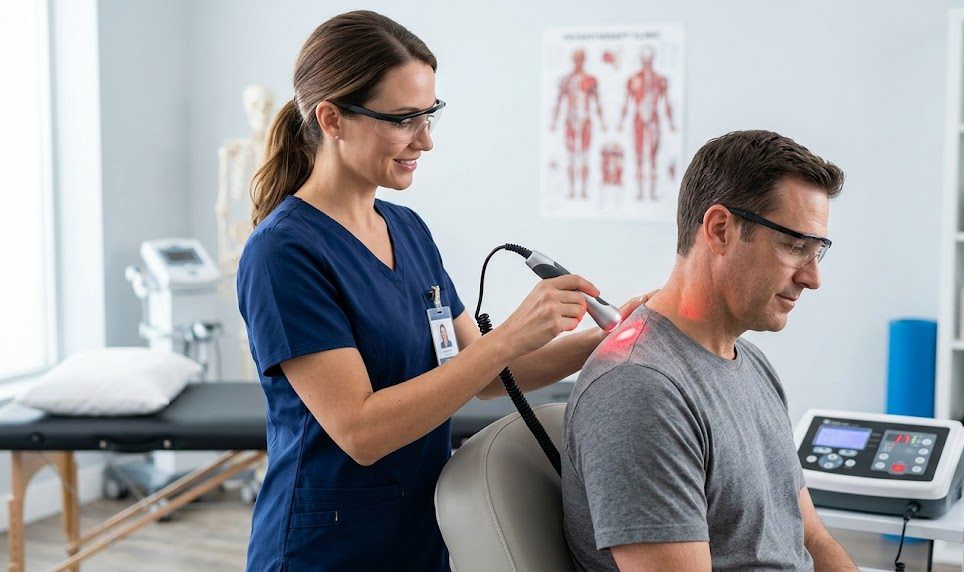
The provider applies the laser device directly to the skin over the target area — whether that’s a joint, muscle group, nerve pathway, or specific region of the skull for neurological applications. The device emits focused light at specific wavelengths, and the session lasts anywhere from a few minutes to 20–30 minutes depending on the area being treated and the goals of the session.
You will not feel heat. You may feel nothing at all, or a mild, pleasant warmth. There is no recovery time — patients typically leave and continue their day normally. There are no known adverse effects when the therapy is properly administered.
Cold Laser Therapy at HML is seldom used in isolation. It is one component of a broader treatment plan — working alongside chiropractic adjustments, functional neurology rehabilitation, and functional medicine support to address the full picture of what a patient needs.
How Many Sessions Are Needed?
This depends on the condition being addressed and the goals of treatment. Acute injuries may respond in a small number of sessions. Chronic conditions and neurological applications typically involve Cold Laser Therapy as an ongoing component of a longer-term care plan.
During your evaluation and review of findings at HML, the doctors will discuss whether Cold Laser Therapy is appropriate for your situation, how it would fit into your overall plan, and what the expected frequency of use looks like.
Is Cold Laser Therapy Right for You?
Cold Laser Therapy is appropriate for a wide range of patients — adults, children, athletes, seniors, and those with complex chronic conditions. Because it is non-invasive and has no adverse effects, it can be safely integrated into care plans that also include chiropractic care, functional neurology, and functional medicine.
If you’re dealing with chronic pain, recovering from an injury, managing a neurological condition, or simply looking for a drug-free tool to support cellular health and healing, Cold Laser Therapy may be a valuable part of your care.
The best way to know is to start with an evaluation.
Learn more about Cold Laser Therapy at HML →
Schedule a consultation in Lee’s Summit →
HML Functional Care | 200 NE Missouri Rd #306, Lee’s Summit, MO 64086 | (816) 768-6000