
When parents first hear about Interactive Metronome therapy, the question is usually some version of: My child has ADHD, not a rhythm problem. How does a metronome help with that?
It’s a fair question, and the answer turns out to be more interesting than most people expect.
Interactive Metronome isn’t about music or rhythm in the way you might think. It’s about the brain’s internal timing system: the millisecond-level precision with which your neural circuits coordinate to make thinking, focus, movement, and language possible. And for many children with ADHD and learning disabilities, that system is measurably off.
The Brain Is a Timing Machine
Everything your brain does requires timing. When you read a sentence, your visual system, language processing areas, and working memory have to fire in a precise sequence. When you hold a conversation, your auditory processing, language production, and social awareness circuits have to synchronize. When you try to stay focused on a task, your prefrontal cortex has to maintain activation against competing inputs — a timing-dependent process.
When that internal timing is disrupted even by milliseconds, it creates ripple effects across attention, processing speed, impulse control, motor coordination, and academic performance. Children with ADHD, dyslexia, autism spectrum disorders, TBI, and speech and language delays frequently show patterns consistent with neural timing difficulties.
This is the problem Interactive Metronome (IM) is designed to address.
What Is Interactive Metronome?
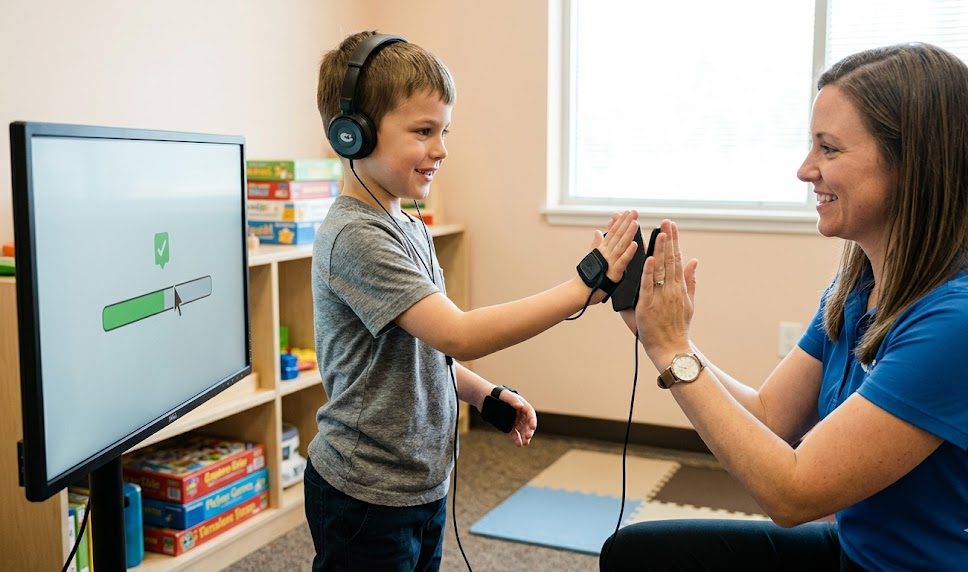
Interactive Metronome is a computer-based brain training program that uses real-time audio and visual feedback to train the brain’s timing and rhythm at the neural level. During an IM session, the child wears a headset and performs a series of rhythmic movements — clapping, tapping, or stepping, while trying to synchronize precisely with a computer-generated beat.
Here’s what makes it more than just a coordination exercise: the system measures the child’s timing accuracy down to the millisecond, providing immediate feedback when they’re early, late, or on time. That constant, precise feedback is what drives neural adaptation. The brain is being asked to self-correct in real time, and over repeated sessions, it gets better at it.
The result isn’t just improved rhythm. It’s improved neural timing across the systems that timing underlies: attention, processing speed, language, and motor control.
How IM Helps Children with ADHD
ADHD is fundamentally a problem of regulation, the brain’s ability to maintain focus, inhibit impulses, and sequence behavior toward a goal. All of these functions depend on the prefrontal cortex and its connections to the cerebellum and basal ganglia, and all of them are timing-dependent.
Interactive Metronome directly trains the prefrontal-cerebellar timing circuits that ADHD affects. Children who have undergone IM therapy have reported improvements across several areas, including:
- Sustained attention — the ability to stay focused on a task without drifting
- Impulse control — better ability to pause before acting
- Processing speed — faster and more efficient cognitive response
- Working memory — holding and manipulating information in the moment
- Motor coordination — better physical control and body awareness
IM is used in clinical, educational, and rehabilitation settings across the country, and many families and practitioners report meaningful improvements in attention, impulse control, and processing speed through consistent use.
At HML Functional Care, Interactive Metronome is integrated into a broader functional neurology treatment plan, not used in isolation. The IM findings help inform the overall picture of a child’s neural timing, and the therapy works alongside the targeted neurological exercises that address the underlying brain pattern driving their ADHD presentation.
How IM Helps Children with Learning Disabilities
Learning disabilities like dyslexia, processing disorders, and language delays have a neurological foundation that’s closely related to timing. Reading, in particular, requires extremely rapid and precise sequencing of visual and auditory information. When the brain’s timing circuits aren’t synchronized, decoding words and connecting sounds to letters becomes far harder than it should be.
Interactive Metronome has been explored in the context of dyslexia and reading difficulties with promising results. By improving the brain’s ability to process sequential information in a timed way, IM may support improvements in:
- Phonological processing — the ability to break words into sounds and manipulate them
- Reading fluency and comprehension — smoother, faster decoding
- Language sequencing — the ability to organize and express language clearly
- Academic performance more broadly, across subjects that require processing speed and sustained attention
For children struggling with dyslexia or other learning disabilities, IM is one piece of a functional neurology approach that also looks at visual processing (often evaluated using RightEye), motor development, and the full neurological picture.
What an IM Session Looks Like
For children who haven’t experienced it, the idea of brain training can sound abstract or intimidating. In practice, it’s nothing like that.
A typical IM session at HML involves the child using hand and foot sensors to tap or clap in time with the computer’s beat. The system gives them instant feedback; they can see and hear whether they’re on time, early, or late, and the provider adjusts the challenge level as they improve. Session length varies based on the individual plan.
Most children find it genuinely engaging. It has the structure and feedback loop of a game, and kids tend to be motivated by improving their scores. The doctor guides them through the exercises and tracks progress over time, adjusting the plan based on what the measurements show.
Who Can Benefit from Interactive Metronome at HML?
Interactive Metronome is used at HML with children (and adults) presenting with:
- ADHD — all three presentations
- Dyslexia and learning disabilities
- Autism spectrum disorders — particularly for motor coordination, sensory processing, and communication
- Traumatic brain injury — for cognitive and motor rehabilitation
- Speech and language delays, and developmental coordination challenges
It’s also used with athletes seeking improved reaction time and with adults dealing with the cognitive effects of chronic conditions.
Part of a Larger Picture
At HML, Interactive Metronome is always used as part of a broader functional neurology evaluation and treatment plan. The IM assessment tells us something specific and measurable about a child’s neural timing, and that information shapes the rest of the plan.
If you’ve been looking for a more targeted, neurologically grounded approach to supporting your child’s attention and learning, a functional neurology plan that includes IM may be worth exploring.
Learn more about Interactive Metronome at HML →
Schedule a consultation in Lee’s Summit →
HML Functional Care | 200 NE Missouri Rd #306, Lee’s Summit, MO 64086 | (816) 768-6000