
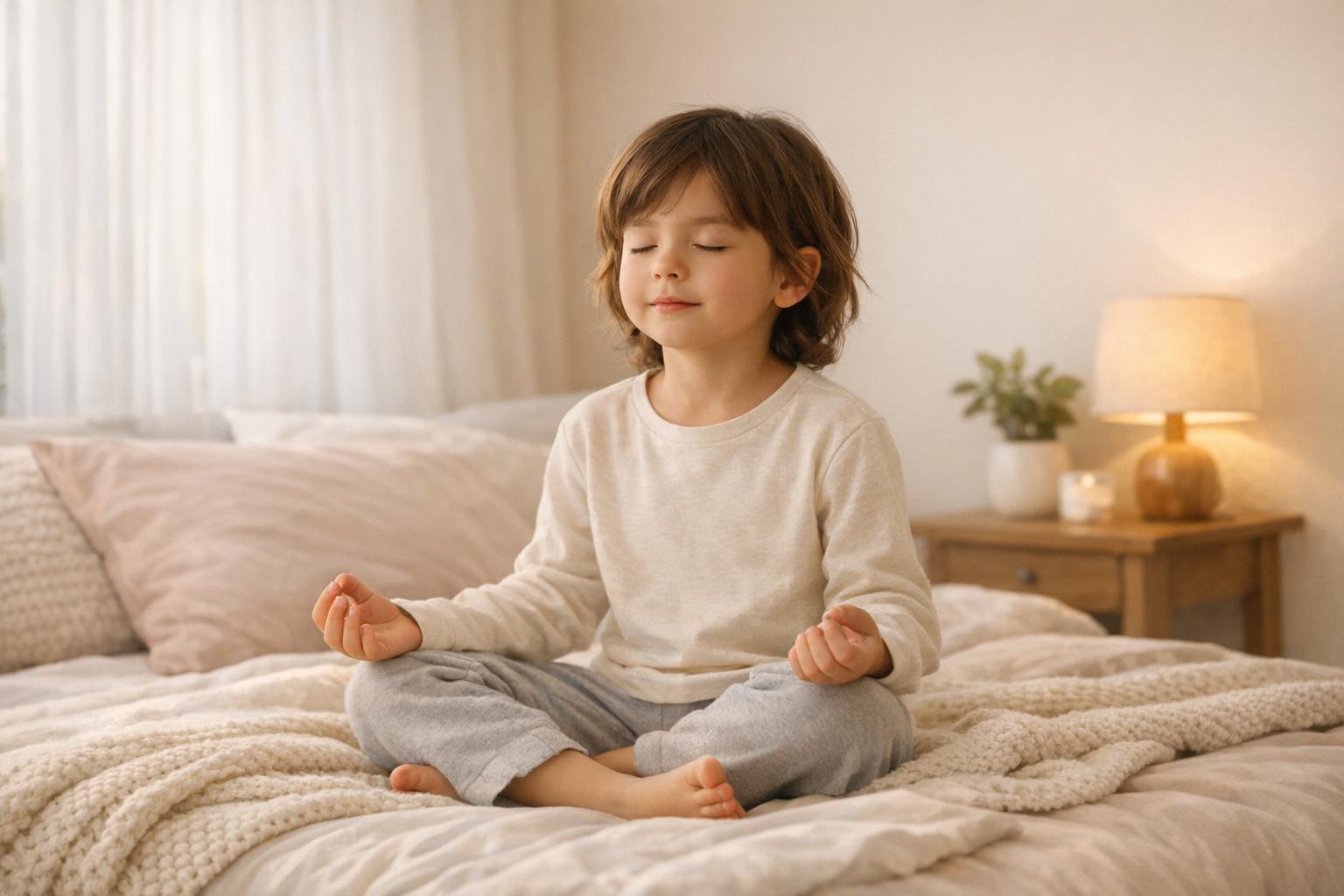
Meditation can help neurodivergent kids sleep better by reducing stress, calming the mind, and addressing challenges like sensory sensitivity and melatonin imbalances. Studies show improvements in sleep quality, emotional regulation, and overall well-being for children with ADHD and autism. Key findings include:
- ADHD: Meditation helps reduce hyperactivity, impulsivity, and racing thoughts, improving sleep onset and duration. An 8-week mindfulness program improved sleep significantly (p = 0.002).
- Autism: Tailored techniques, like mantra meditation and sensory-friendly practices, address unique sleep challenges. A 10-day program improved social behavior and reduced anxiety.
- Consistency Matters: Short, daily sessions of 5 to 10 minutes are more effective than long, infrequent ones.
- Parent Involvement: Teaching parents mindfulness techniques improves home routines and sleep outcomes.
While promising, research still faces challenges like small sample sizes and limited long-term data. However, meditation offers a practical, non-medication option for better sleep and emotional balance in neurodivergent children.
Research on Meditation for ADHD and Sleep Problems
Emerging research highlights how meditation may help with sleep challenges, particularly for individuals with ADHD. Sleep issues are a common struggle for children with ADHD, affecting 25 to 50% of this group. Controlled trials have shown that meditation can improve the time it takes to fall asleep and the overall duration of sleep. These findings offer a solid foundation for diving deeper into individual study results.
8-Week Mindfulness-Oriented Meditation Study
In this trial, 25 children aged 7 to 11 participated in an 8-week mindfulness-oriented meditation (MOM) program. The program included exercises that emphasized breath awareness, body sensations, and observing thoughts, all presented interactively. Parents reported notable improvements in their children’s ability to both fall asleep and stay asleep, with a statistical significance of p = 0.002, suggesting the results were unlikely due to chance. The study also found that holding sessions twice a week was manageable for families while still delivering meaningful benefits.
4-Week Headspace Digital Meditation Pilot Study
This pilot study explored the potential of a digital meditation app to improve sleep. Eighteen children aged 6 to 12 used the Headspace app for 4 weeks, engaging in short, age-appropriate guided meditations at home. Despite the shorter duration and digital format, the study reported a moderate improvement in sleep issues, with an effect size of d = 0.47, indicating a noticeable benefit.
Meta-Analyses of ADHD Meditation Trials
A 2023 meta-analysis reviewed 14 randomized controlled trials (n = 832) and found that more than 16 hours of meditation led to medium-level improvements in executive function, which plays a key role in self-regulating sleep patterns. Another review reported that mindfulness practices improved attention by 66% while reducing hyperactivity and impulsivity by 53%, all of which contribute to better sleep quality at night.
Research on Meditation for Autism and Sleep Problems
Sleep issues affect 50% to 80% of autistic children, nearly twice as often as their neurotypical peers, with 53% to 66% experiencing severe disturbances. These challenges often include bedtime resistance, difficulty falling or staying asleep, shorter sleep durations, and daytime fatigue.
Unlike common sleep problems, the root causes for autistic children are often tied to factors like dysregulated arousal, heightened sensory sensitivity, anxiety, and melatonin imbalances. Research reveals that autistic children spend only about 15% of their sleep time in the REM phase, compared to 25% in neurotypical children. This reduced REM sleep significantly impacts learning and memory. Beth Malow, M.D., Professor of Neurology and Pediatrics, highlights the emotional toll of poor sleep:
“When we are sleep deprived, the amygdala and prefrontal cortex do not communicate well, which allows our emotions to go wild.”
Given these unique challenges, tailored approaches like meditation offer promising solutions. Meditation helps regulate brain activity. For example, mantra meditation fosters interhemispheric synchronicity in autistic individuals. Sonia Sequeira from Memorial Sloan-Kettering Cancer Center supports its use, noting:
“Mantra is a feasible and beneficial practice in a clinical setting with children as young as 3 years of age.”
Mindfulness techniques also empower children to recognize and manage emotions, reducing emotional outbursts and distress that often disrupt sleep.
One study found that a 10-day meditation program led to improvements in social behavior, attention, and anxiety levels. Between 2017 and 2022, a randomized trial involving 245 families (called Sleeping Sound with Autism Spectrum Disorder) tested a customized intervention. This program, which included two consultations and a follow-up call, reduced sleep problems with effect sizes of 0.7 at three months and 0.4 at six months. Notably, 95.5% of parents recommended the program.
Successful interventions for autistic children often require adjustments, such as using clear language, incorporating movement-based practices, and creating sensory-friendly environments. Without targeted strategies, sleep challenges in autistic children tend to worsen over time. These findings highlight meditation as a practical, non-medication option to improve sleep and overall well-being in autistic children.
Study Comparison: Meditation Methods and Sleep Results
Research on meditation for neurodivergent children takes a variety of approaches, differing in how practices are structured, how long they last, and how results are measured. These differences shed light on which techniques are most effective for improving sleep in kids with ADHD and autism, offering guidance on tailoring meditation to their unique needs.
One standout finding is the importance of short, consistent practice. Daily sessions lasting just 5 to 10 minutes often yield better results than longer ones. Extended sessions can overwhelm children who find it challenging to maintain focus, so it is more effective to prioritize routine over duration.
When it comes to evaluating results, researchers have relied on a mix of objective and subjective measurement tools:
- Wrist-worn actigraphs track movement and sleep patterns but may bother children with sensory sensitivities.
- Melatonin level testing provides insight into biological sleep regulation, particularly relevant for autistic children.
- Sleep diaries and parent surveys offer valuable subjective perspectives but can be influenced by individual bias.
Another promising area of research lies in mindfulness training for children with neurological differences. Studies have found that improvements in information-processing speed can emerge after just four weeks of practice, with these benefits lasting up to six months after the intervention ends.
How These Findings Apply to Pediatric Care
Recent research highlights how meditation can be incorporated into pediatric care to improve sleep and overall well-being. Studies show that meditation works best when it is part of a broader approach that addresses both physical and emotional health.
At HML Functional Care, children with ADHD and autism receive personalized care plans that integrate Functional Neurology, Functional Medicine, and Chiropractic Care. These evidence-based approaches are tailored to each child’s developmental stage and sensory profile, addressing the neurological and physiological factors that contribute to poor sleep. For naturally active children, movement-based sensory and motor exercises can help channel energy in a calming, constructive way. This reflects HML’s broader philosophy that care should adapt to a child’s unique neurological needs.
Combining these approaches with sensory management strategies can lead to even better results. Simple adjustments such as reducing noise, using blackout curtains, or addressing fabric sensitivities can significantly improve sleep quality. For children with autism or ADHD, brown noise is often recommended to help with focus and sleep. Establishing a consistent bedtime routine that includes 30 minutes of relaxation exercises, like deep breathing and muscle relaxation, can help the body transition into rest mode.
“While it is critical to treat the physical symptoms, it is equally vital to offer an evidence-based holistic solution that harmonizes both their emotional and physical well-being.” — Sonia Sequeira, Memorial Sloan-Kettering Cancer Center
Considering that 44 to 83% of children on the autism spectrum face sleep difficulties, healthcare providers are encouraged to train parents in Mindfulness-Based Stress Reduction (MBSR). Teaching parents these techniques not only reduces their stress but also improves parent-child interactions and enhances overall treatment outcomes. By equipping parents with MBSR skills, families can create a home environment where mindfulness becomes a natural and effective tool for better sleep.
Research Gaps and Future Studies Needed
While earlier findings hint at potential benefits, several critical gaps limit our understanding of meditation’s long-term effects on neurodivergent children. The most pressing issue is the small sample sizes in many studies. For instance, one study included just 6 parent-child pairs, while another involved only 18 children. These limited participant numbers make it difficult to draw conclusions that apply to the broader ADHD and autism populations.
Another major challenge lies in the methodological weaknesses of existing research. A systematic review of mindfulness interventions for Autism Spectrum Disorder revealed that half of the studies were rated as weak in their design. Similarly, 80% of non-randomized controlled trials for ADHD were rated as only fair in quality. Even among randomized controlled trials, only 44% properly concealed participant allocation, and the same percentage accounted for concurrent treatments like medication.
“Many of the studies lacked blind assessment, adequate randomization, or suitable control conditions.” — Clara R. Kretschmer, Department of Psychology, King’s College London
These issues highlight the need for more robust and well-structured research designs.
Another significant gap is the lack of long-term follow-up in current studies. Most research tracks outcomes for just 4 to 8 weeks, which may not be enough time to capture the full benefits of meditation. For example, one study found no immediate improvement in ADHD symptoms after the intervention but noted significant progress at a 6-month follow-up. Similarly, sleep problems in autistic children tend to worsen over time without intervention, emphasizing the importance of extended follow-up periods to assess whether meditation can provide lasting relief.
To advance meditation as a dependable intervention, future research must address these gaps. Studies should incorporate objective sleep tracking methods, such as actigraphy or polysomnography, rather than relying solely on parent-reported questionnaires. Additionally, research should include a broader range of participants covering children under 8, those from diverse socioeconomic backgrounds, and individuals across the neurodivergent spectrum. Understanding which meditation techniques work best for different age groups and neurotypes will enable healthcare providers to design more effective, tailored interventions.
Conclusion
Research highlights that meditation can positively impact sleep in neurodivergent children. For instance, a 4-week digital mindfulness program tailored for kids with ADHD showed a reduction in anxiety and sleep disturbances. Similarly, a school-based mindfulness curriculum led to children gaining an average of 74 extra minutes of sleep per night, including nearly 24 additional minutes of REM sleep, a vital phase for brain development and emotional balance.
These findings underline the potential for real-life benefits. Sleep disorders affect about 40% to 80% of children with autism and 25% to 50% of children with ADHD. Poor sleep often worsens core challenges like emotional regulation, repetitive behaviors, and communication struggles. By improving sleep through mindfulness-based strategies, children may experience meaningful improvements in these areas, enhancing their overall quality of life.
Meditation offers flexibility, with options ranging from deep breathing exercises and digital tools like Headspace to family-based mindfulness programs. Parents also gain from the practice. When families engage in mindfulness together, the home environment often becomes more harmonious.
Is your child struggling with sleep?
At HML Functional Care in Lee’s Summit, MO, Dr. Alex and Dr. Lauren Nelson specialize in helping neurodivergent children with ADHD and autism through an integrated approach combining Functional Neurology, Functional Medicine, and Chiropractic Care. If your child faces sleep challenges, we invite you to schedule a consultation to explore a personalized care plan.
FAQs
How can meditation help neurodivergent children sleep better?
Meditation has a soothing effect on the nervous system, helping to lower anxiety and stress while enhancing emotional regulation, all essential ingredients for improving sleep quality. These effects can be especially helpful for neurodivergent children, such as those with ADHD or autism, who often face challenges with falling asleep and staying asleep.
By encouraging relaxation and easing overstimulation, meditation helps create the right conditions for both the mind and body to unwind. This makes it easier for children who struggle with restlessness or difficulty settling down at night to experience a more peaceful and restorative sleep.
What meditation techniques can help children with ADHD or autism sleep better?
Meditation, when adapted to suit individual needs, can make a big difference in improving sleep for neurodivergent children. For kids with ADHD, incorporating movement into meditation can be particularly effective. Techniques like gentle yoga or walking meditations allow them to channel their energy in a calming way. Breathing exercises, such as deep belly breaths paired with visual aids like blowing bubbles, can also help them relax. Keeping sessions short and structured, around 2 to 5 minutes, helps maintain their focus without causing frustration.
For children on the autism spectrum, sensory-friendly approaches are essential. Guided imagery, like picturing a peaceful place, can encourage relaxation, while tactile tools such as a smooth stone or a weighted lap pad provide a sense of security. Including these practices in a bedtime routine can create a smoother, more calming transition to sleep.
At HML Functional Care, families receive personalized support to help integrate evidence-based strategies into daily life, fostering better sleep and overall well-being for children with ADHD and autism.
Why is it important for neurodivergent children to practice meditation regularly for better sleep?
Regular meditation can enhance the brain’s capacity to handle stress while encouraging a sense of calm. Over time, consistent practice helps soothe the mind and minimizes the effects of overstimulation, a common hurdle for neurodivergent children.
With regular meditation, children may enjoy steadier, more restful sleep, which plays a crucial role in supporting their overall health and daily activities.
Book an appointment with HML Chiropractic & Functional Care or call us at (816) 768-6000. Our practice is located at 200 NE Missouri Rd, Suite 306, Lee’s Summit, MO 64086.