
Did you know that 8 out of 10 Americans experience low back pain at some point? While exercises are commonly recommended, your breath – something you use 20,000 times daily – can also help. Proper breathing techniques reduce muscle tension, improve spinal support, and ease stress. Here’s how:
- Diaphragmatic Breathing: Strengthens your core by engaging your diaphragm, reducing chest compression, and stabilizing your spine.
- 4-7-8 Breathing: Calms your nervous system, lowers cortisol, and eases tension during acute pain.
- Box Breathing: Balances breathing patterns, sharpens focus, and promotes spinal alignment.
Studies show diaphragmatic breathing can cut back pain by 58% in 8 weeks. Practicing these techniques for 5–10 minutes daily can transform posture, reduce discomfort, and improve overall well-being. Simple steps like syncing your breath with daily movements can make a big difference. Consistency is key – start today for lasting relief.
Diaphragmatic Breathing: The Core Technique
Diaphragmatic, or belly breathing, engages your diaphragm – a dome-shaped muscle essential for deep, efficient breathing. Unlike shallow chest breathing, which relies on your neck and shoulder muscles, this method promotes full oxygen exchange and helps stabilize your core. As the Cleveland Clinic puts it:
“The diaphragm is the most efficient muscle for breathing… Your abdominal muscles help move the diaphragm and give you more power to empty your lungs.”
Picture your core as a cylinder: the diaphragm forms the top, the pelvic floor acts as the base, and the abdominal muscles make up the walls. Proper breathing causes the diaphragm to contract and move downward, generating intra-abdominal pressure that supports your spine, much like a natural weight belt. This not only enhances breathing efficiency but also strengthens spinal stability, which is crucial for alleviating back pain.
On the other hand, chest breathing raises the shoulders, triggers stress responses, and increases tension in the neck and upper back. Diaphragmatic breathing, however, shifts the focus to expanding the abdomen. This activates the body’s relaxation response and minimizes the strain on overworked accessory muscles. Over time, many adults develop shallow breathing habits, often due to tightening their abdominal muscles for aesthetic reasons, which can weaken the diaphragm.
Now that you understand its importance, let’s break down how to practice this technique step by step.
How to Practice Diaphragmatic Breathing
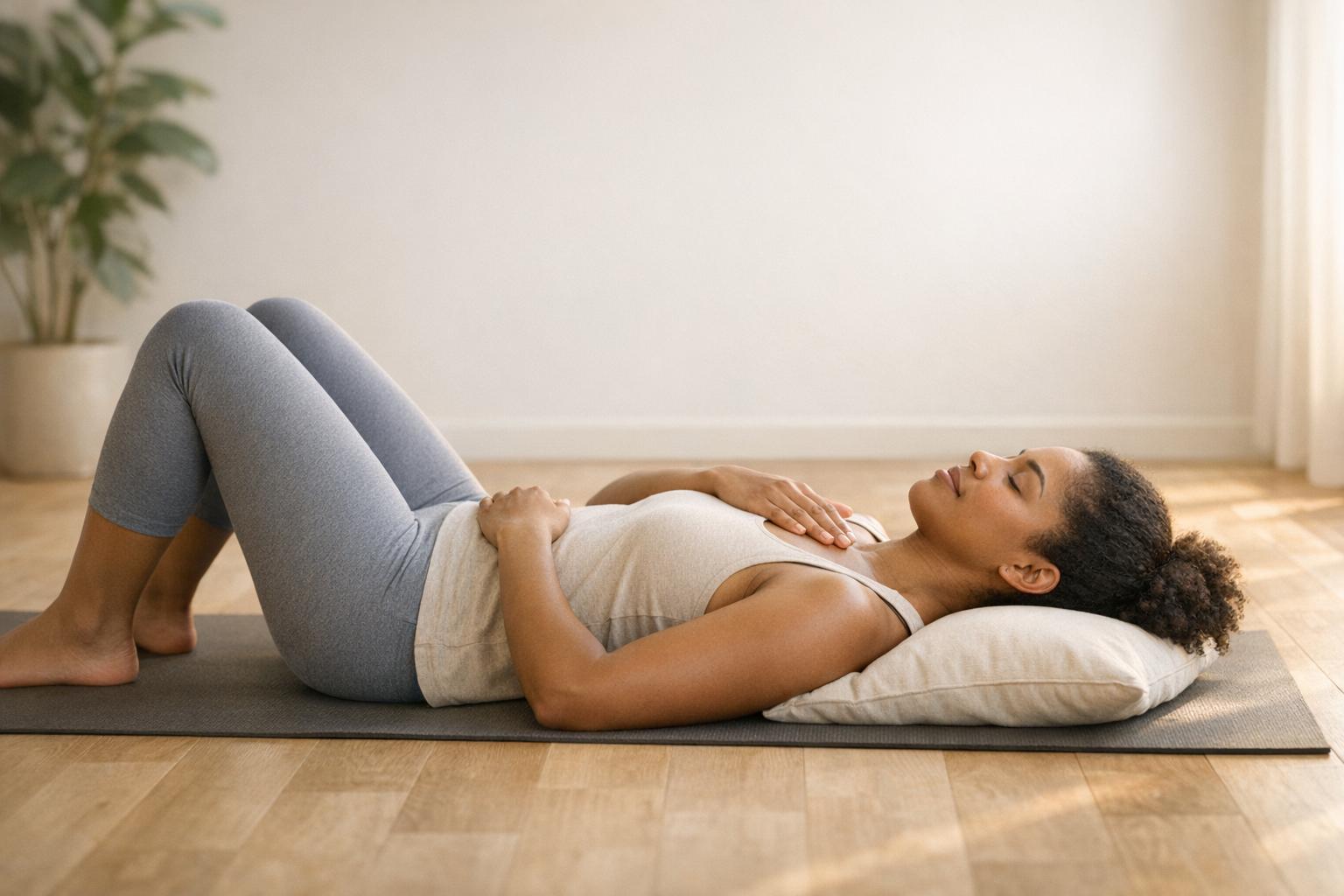
Start by lying on your back with your knees bent and feet flat on the floor. Place one hand on your chest and the other on your belly, just below your rib cage.
- Inhale slowly through your nose for a count of four. Focus on raising the hand on your belly while keeping the hand on your chest still. Imagine your entire midsection expanding – front, sides, and back – like a balloon inflating.
- Exhale gently through pursed lips (as if blowing through a straw) for about six seconds. Feel your abdomen contract as you release the air.
Practice this for 5–10 minutes, three to four times daily. Once you’re comfortable with this lying-down position, try it seated, then standing. Eventually, incorporate it into everyday activities like walking or lifting. With consistent practice, this technique can transform your breathing patterns and improve your body mechanics.
Benefits of Diaphragmatic Breathing
This approach tackles the underlying issues of posture-related back pain. Since the diaphragm connects to the lumbar vertebrae, its rhythmic movement helps stabilize and massage the lower back, providing internal spinal support.
It also relieves chronic tension. By shifting the workload from the neck and shoulder muscles to the diaphragm, those overused muscles can finally relax, easing the tightness that often contributes to back pain. Additionally, deep breathing stimulates the vagus nerve, lowering cortisol levels and activating the parasympathetic nervous system – your body’s natural relaxation mode.
For tailored advice on incorporating diaphragmatic breathing into your back pain relief plan, visit HML Chiropractic & Functional Care (https://hmlfunctionalcare.com).
4-7-8 Breathing for Relaxation and Pain Relief
The 4-7-8 breathing technique is a rhythmic method inspired by Pranayama practices, brought into the spotlight by Dr. Andrew Weil, who describes it as a “natural tranquilizer” for the nervous system. Unlike diaphragmatic breathing, which enhances core stability, this approach is specifically designed to ease stress and relax muscles during moments of acute pain. While diaphragmatic breathing focuses on physical support, 4-7-8 breathing directly targets the stress response, helping to release tension.
When back pain strikes, the body often shifts into “fight or flight” mode. This triggers the release of stress hormones like cortisol, which can tighten muscles and create a cycle of pain and tension. The 4-7-8 breathing technique works to interrupt this cycle by stimulating the vagus nerve. This nerve plays a key role in activating the body’s relaxation response, reducing cortisol levels, and easing muscle tension. Dr. Chiti Parikh, Executive Director of the Integrative Health and Wellbeing Program at Weill Cornell Medicine, highlights this:
“It activates the vagus nerve, which is responsible for the relaxation response. When the vagus nerve is activated through breathing, it can help reduce cortisol and anxiety.”
Scientific studies back these claims. Research from 2022 shows that this method improves heart rate variability and helps regulate blood pressure, which can reduce strain on the heart. Even just five minutes of controlled, slow breathing can have a noticeable impact on stress and anxiety levels.
How to Practice 4-7-8 Breathing
To get started, find a comfortable position – either sitting upright or lying down. Place the tip of your tongue against the ridge of tissue just behind your upper front teeth. Keep it there throughout the exercise to maintain a steady rhythm.
- Step 1: Exhale completely through your mouth, making a “whoosh” sound.
- Step 2: Close your mouth and inhale quietly through your nose for a count of 4.
- Step 3: Hold your breath for a count of 7.
- Step 4: Exhale forcefully through your mouth, producing a “whoosh” sound for a count of 8.
This completes one cycle. Begin with four cycles twice a day – this takes only about 90 seconds. As you grow more comfortable, you can gradually increase to eight cycles per session. If the 7-count breath hold feels difficult, you can adjust the pace while keeping the 4:7:8 ratio intact. Some lightheadedness is common initially but usually fades with practice.
Why It Works for Back Pain
The calming effect of the 4-7-8 technique is largely due to the extended exhale. While inhaling naturally raises the heart rate, exhaling slows it down, which helps reduce stress hormones that contribute to muscle tension and back pain.
Additionally, this controlled breathing creates intra-abdominal pressure, which stabilizes the spine and reduces strain on spinal discs. Unlike medications for anxiety or pain, which may lose effectiveness over time, the benefits of 4-7-8 breathing build with consistent practice.
Incorporating this technique into your daily routine can be a simple yet powerful way to manage back pain. At HML Chiropractic & Functional Care, we focus on a whole-body approach to spinal health. Techniques like 4-7-8 breathing can complement other therapies, offering a well-rounded path to relief.
Box Breathing for Stability and Focus
Box breathing, sometimes referred to as square breathing (and also known as sama vritti pranayama), stands out among breathwork techniques for its balanced and rhythmic approach. Unlike methods like 4-7-8 breathing, which primarily aim to calm the nervous system, box breathing focuses on fostering both mental clarity and physical stability. The technique is built on four equal phases: inhale, hold, exhale, and hold.
This practice actively engages the diaphragm, forming what’s often called a “core cylinder.” This process enlists the abdominals, obliques, and back muscles to provide spinal support. Dr. Kevin Spahr from PRO Therapy explains:
“Think of your diaphragm as a large, dome-shaped muscle… its secondary job is just as critical: core stabilization.”
During each inhale, the diaphragm increases intra-abdominal pressure, delivering internal support to the spine. At the same time, the structured counting in box breathing acts as a meditative tool, redirecting attention away from discomfort and sharpening focus. It’s no surprise that U.S. Navy SEALs rely on this technique to stay calm and precise in high-stakes scenarios.
Scientific studies back up these claims. A 2024 study revealed that box breathing was 99.2% effective in regulating respiratory rates. Additionally, a 2023 study found that practicing breathwork, including box breathing, for just five minutes daily significantly reduced anxiety and improved mood.
How to Practice Box Breathing
To get started, find a comfortable position. Sit with your back supported and feet flat on the floor, or lie down if that feels more natural. Place one hand on your chest and the other on your stomach to ensure you’re engaging in deep belly breathing rather than shallow chest breathing.
Here’s how to practice box breathing:
- Inhale: Through your nose, breathe in for 4 seconds, letting your abdomen expand.
- Hold: Pause your breath for 4 seconds, activating your parasympathetic nervous system.
- Exhale: Slowly release your breath through your mouth for 4 seconds, fully emptying your lungs and relaxing your shoulders.
- Hold: Pause again with empty lungs for 4 seconds before starting the next cycle.
Start with 1–5 minutes of practice and gradually increase to 10–20 minutes daily. If a 4-second count feels challenging at first, shorten it to 2 or 3 seconds, keeping all four phases equal. Dr. Melissa Young, an Integrative Medicine Specialist at Cleveland Clinic, highlights the simplicity of this method:
“Box breathing’s simplicity is its greatest strength. When you start out with other forms of breathwork, you can almost get more anxious by overthinking it.”
With consistent practice, this technique not only sharpens focus but also improves postural alignment.
Benefits for Posture and Core Strength
Beyond its mental benefits, box breathing also supports physical health by improving posture and core stability.
This technique retrains the body to use proper breathing mechanics. Shallow chest breathing, which often overworks accessory muscles, is replaced by full diaphragmatic engagement. Since the diaphragm attaches directly to the lumbar vertebrae, using it correctly provides essential spinal support. Kevin Kang, a physiotherapist at The Brisbane Spine Clinic, explains:
“A proper diaphragmatic breath can create gentle pressure (intra-abdominal pressure) which is understood to help stabilize the spine, similar in principle to a weightlifter’s belt.”
Practicing box breathing regularly enhances postural awareness by encouraging better lung expansion and maintaining healthy spinal alignment throughout the day. In just five minutes, it can balance the nervous system, ease muscle tension, and alleviate chronic pain. Dr. Melissa Young adds:
“The nervous system is not fixed; it’s plastic. We can change it by learning how to be less responsive to stress and how to calm that response.”
At HML Chiropractic & Functional Care, we emphasize the value of integrating breathing techniques like box breathing into your routine. This practice complements hands-on treatments, helping you achieve a balanced state – alert and grounded, yet not overly tense or too relaxed – perfect for tackling daily challenges.
Using Breathing Techniques During Movement and Daily Activities
Mastering static breathing techniques is just the beginning. The real game-changer is applying these methods to your everyday life – whether you’re lifting groceries, tying your shoes, or even sitting at your desk. With the average person taking 20,000 to 24,000 breaths a day, each breath has the potential to either support or strain your spine. By integrating these techniques into your daily routine, you can turn ordinary movements into habits that promote spinal health.
Breathing with Proper Posture
Your diaphragm plays a key role in stabilizing your back, as it connects directly to your lumbar spine and rib cage. Breathing correctly helps create a “core canister”, generating intra-abdominal pressure that supports and protects your spine.
When sitting at your desk, practice a “Seated Breath“: inhale to lengthen your spine and lift your head, then exhale to relax your shoulders and neck. This simple adjustment can counteract the forward-head posture often caused by prolonged sitting. Breathing through your nose not only helps maintain good posture but also enhances oxygen delivery.
For standing, try the “back-opening technique.” As you inhale, imagine directing your breath toward your tailbone and along your ribcage – this mental focus helps lift your ribs away from your hips, creating more space in your spine. Keep your shoulders relaxed; if they rise during inhalation, it might signal shallow chest breathing, which can be a sign of stress.
Pairing Breathing with Gentle Movements
Once you’ve developed proper seated and standing posture, take it a step further by combining controlled breathing with your daily movements. A helpful rule of thumb: inhale to extend and lengthen your spine, and exhale to flex and engage your core. This approach not only protects your back but also turns everyday tasks into opportunities for spinal support.
- Lifting: Inhale to engage your core, then exhale to stabilize your spine as you lift.
- Bending and hinging: Inhale to lengthen your spine, then exhale as you hinge at your hips to avoid compressing your spine.
- Walking: Make walking therapeutic by syncing your breath with your steps – try inhaling for 3–4 steps and exhaling for the same number to maintain a steady rhythm and spinal alignment.
- Stretching: For stretches like Cat-Cow, inhale to open your chest during the “Cow” phase and exhale to round your back during the “Cat” phase, engaging your deep core.
- Twisting: Use your inhale to create space between vertebrae and exhale to rotate safely.
Research shows that proper breathing techniques can reduce spinal compression forces by up to 40%. Dr. Stuart McGill, a leading expert in spine biomechanics, emphasizes:
“Intra-abdominal pressure generation through breathing is fundamental to spine protection”.
At HML Chiropractic & Functional Care, we help patients incorporate these breathing patterns into their daily lives, complementing hands-on treatments with practical self-care strategies for long-term relief.
Building a Daily Practice for Long-Term Relief
Once you’ve learned diaphragmatic, 4-7-8, and box breathing techniques, the key to long-term relief lies in consistency. Making these exercises part of your daily routine is essential. Give your body several weeks to adapt to these new habits.
How Often and How Long to Practice
Begin with 5–10 minutes of diaphragmatic breathing each day. If that feels like too much at once, break it into smaller chunks – try 2–4 minute “micro-drills” spread throughout your day. These brief sessions can reinforce proper breathing patterns and help improve spinal alignment. For 4-7-8 breathing, aim for 4 cycles, and for box breathing, practice 5–10 rounds.
You might notice some improvement in 2–3 weeks, but more lasting results often take 8–12 weeks of consistent practice. Research suggests that programs lasting over 4 weeks with at least 12 sessions yield greater reductions in pain and disability.
To build a habit, try “habit stacking.” For instance, start with a morning breathing session for 2–3 weeks. Then, add an evening session to wind down. Hourly reminders can also help – take 3–5 deep breaths to reset your posture. If you’re desk-bound, every 20–30 minutes, take a deep inhale to lengthen your spine and exhale slowly to release tension in your shoulders.
Once you’ve established a routine, track your progress to refine your practice.
Monitoring Progress and Adjusting Your Practice
Pay attention to how your body responds. Are your neck muscles relaxing more during inhalation? Do your ribs expand outward and backward rather than just forward? Does your posture feel naturally aligned without constant effort?
A simple way to check your progress is the “hand test.” Place one hand on your belly and the other on your chest – your belly hand should move more than your chest hand. As you improve, transition from lying down to sitting, then standing, and eventually incorporate proper breathing into functional movements like lifting or bending.
If you feel dizzy, slow your breathing or shorten the session – never force deep breaths. At HML Chiropractic & Functional Care, we guide patients in tracking their progress and fine-tuning their breathing techniques. This ensures these habits become second nature, supporting long-term spinal health and overall well-being.
Conclusion
Back pain doesn’t have to be a lifelong struggle. Techniques like diaphragmatic breathing, 4-7-8 breathing, and box breathing can make a real difference. Diaphragmatic breathing, for instance, strengthens core stability, while 4-7-8 breathing activates the relaxation response to ease muscle tension. Box breathing not only sharpens focus but also supports better posture.
The research is compelling. A study in the Journal of Physical Therapy Science found that diaphragmatic breathing reduced chronic low back pain by 58% after just 8 weeks. Additionally, proper breathing techniques can lower spinal compression forces by as much as 40%. Considering you take roughly 20,000 breaths a day, shallow breathing can place unnecessary stress on your spine. This highlights how essential proper breathing is for maintaining spinal health.
“Mastering your breath is the first, most fundamental step in building a resilient, pain-free back. It calms your nervous system, reduces tension in your neck and shoulders, and provides crucial stability to your spine.”– Dr. Kevin Spahr, Founder, PRO Therapy
Consistency is key to seeing results. With just 5–10 minutes of daily practice, these techniques can help build core stability, relieve tension, and encourage better posture. Most people notice meaningful changes after 8–12 weeks of regular practice. Simple steps, like setting hourly reminders to take 3–5 deep breaths, can help reset your posture throughout the day. Whether you’re commuting, working at your desk, or winding down at night, integrating these techniques into your routine can lead to noticeable improvements.
At HML Chiropractic & Functional Care, we specialize in creating personalized breathing practices tailored to each individual. These small, consistent efforts can lead to long-term spinal health and overall well-being. Your breath is a powerful tool – use it wisely, stay consistent, and experience lasting relief.
FAQs
Which breathing technique is best for my back pain?
Diaphragmatic breathing stands out as a highly effective way to manage back pain. This technique involves taking deep, slow breaths that activate your diaphragm. By doing so, you naturally improve your posture and give your spine better support. Making this a regular practice can ease discomfort and contribute to healthier back function overall.
Can breathing make my core stronger without exercise?
Yes, certain breathing techniques can effectively engage and strengthen your core without the need for traditional workouts. For instance, diaphragmatic breathing activates essential core muscles like the diaphragm, pelvic floor, and transverse abdominis. This not only enhances stability and posture but also helps create intra-abdominal pressure, which supports the spine and may alleviate back pain. While these methods aren’t a substitute for regular exercise, they can be incredibly beneficial for individuals with limited mobility or those recovering from injuries.
When should I stop and see a professional for back pain?
If your back pain persists for more than a week, becomes more intense, feels severe, or is accompanied by symptoms such as numbness, weakness, or tingling in your arms or legs, it’s time to consult a professional. You should also seek medical attention if the pain doesn’t improve after trying home remedies like over-the-counter pain medications or heat and cold therapy.