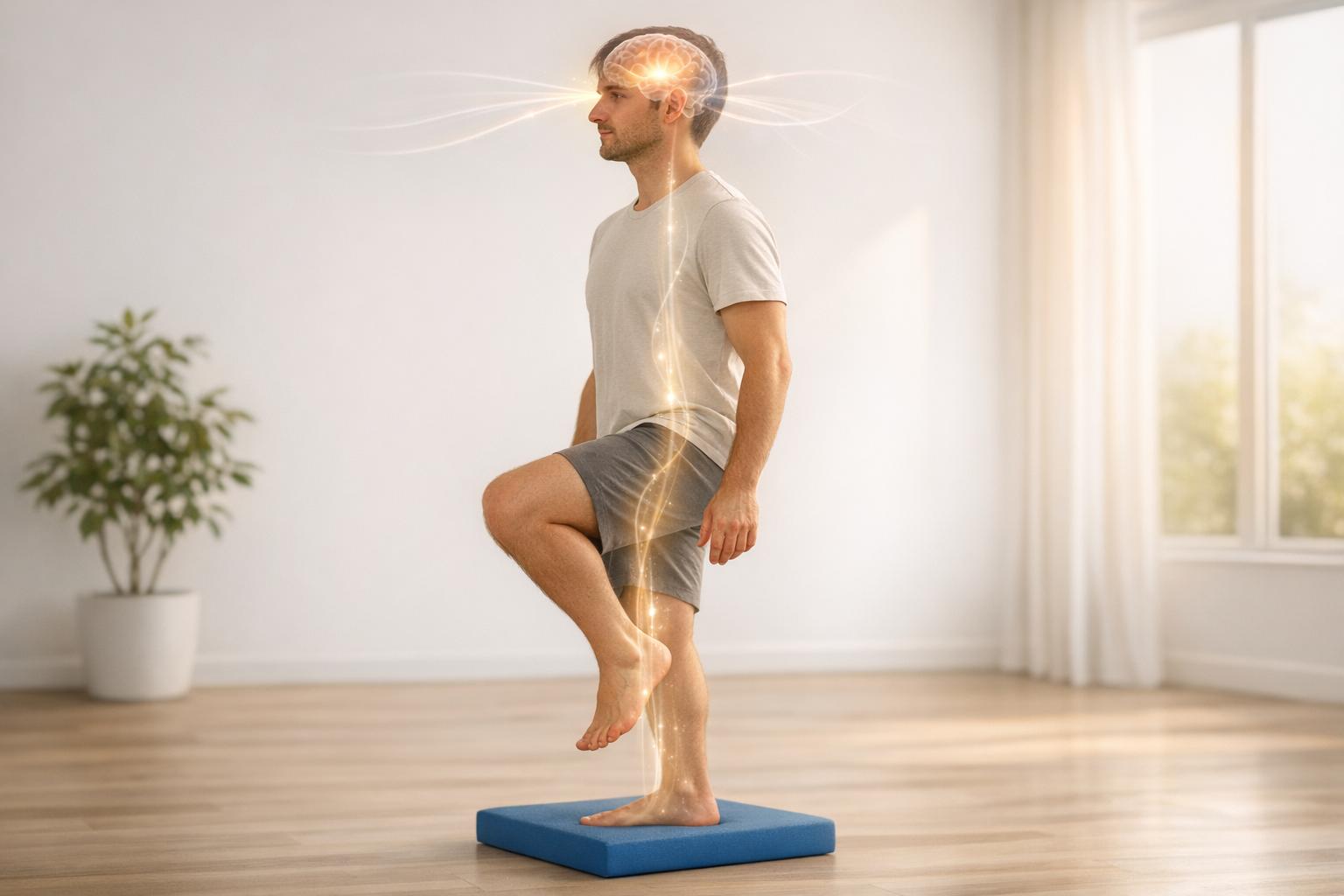
Functional neurology and sensory reorganization focus on improving brain function by leveraging its natural ability to rewire itself, known as neuroplasticity.
- Functional neurology addresses issues in how neurons communicate, often using exercises like eye movement training and balance activities to optimize neural pathways. It’s particularly helpful for conditions like ADHD, migraines, and concussions.
- Sensory reorganization helps the brain adapt after sensory loss or injury. For example, blind individuals may develop heightened touch sensitivity as their brain repurposes visual areas to process tactile input.
Both approaches aim to improve neural communication and sensory processing, offering solutions for complex neurological challenges and localized sensory deficits.
| Feature | Functional Neurology | Sensory Reorganization |
|---|---|---|
| Best For | Complex conditions (e.g., ADHD, migraines) | Sensory loss or localized issues (e.g., vertigo) |
| Key Techniques | Eye movement exercises, balance training | Sensory substitution, targeted reinnervation |
| Speed of Results | Faster results in some cases | Longer protocols (e.g., 12 weeks) |
| Limitations | Requires skilled practitioners and patient effort | Risk of maladaptive outcomes like pain |
1. Functional Neurology
Mechanisms of Action
Functional neurology works by tapping into the brain’s ability to adapt and change – what’s often referred to as neuroplasticity. Through carefully designed sensory, motor, or cognitive exercises, it aims to reshape how neurons communicate. The idea is simple but powerful: neurons fire based on a balance of activating and inhibiting signals. By managing these signals with targeted exercises, practitioners can encourage the brain to form new pathways or reinforce existing ones, improving communication between different neural regions.
One of the key players in this process is proprioception – your body’s natural awareness of its position and movement in space. Chiropractors trained in functional neurology use precise spinal and extremity manipulations to send specific sensory signals to targeted brain areas. Considering that about 90% of the brain’s workload is tied to essential functions like regulating heart rate and digestion through brainstem activity, even small changes in neural communication can ripple out to affect overall health.
Clinical Applications
Functional neurology shines when addressing conditions that traditional imaging techniques might miss. These are often referred to as functional lesions – cases where symptoms persist despite normal test results. This approach has shown promise in managing a wide variety of conditions, including vertigo, ADHD, autism spectrum disorders, concussions, Parkinson’s disease, and chronic pain syndromes like fibromyalgia. It’s particularly helpful for the estimated 15% to 30% of patients with neurological issues who don’t respond well to conventional treatments.
At HML Chiropractic & Functional Care, these principles are applied to support patients dealing with developmental disorders, brain injuries, and chronic health challenges. Treatments might include exercises to improve eye movement, monitored through Video Nystagmography (VNG), or therapies that integrate sensory inputs like sight, sound, touch, and body awareness. These methods aim to reorganize brain function, leading to measurable improvements in neural activity.
Evidence and Research Support
Currently, more than 700 board-certified functional neurology practitioners worldwide use these techniques to address neurological disorders, which affect over 1 billion people globally. Tools like VNG testing provide objective data, showing improvements in eye movement speed, accuracy, and response times.
“The ability to show changes on VNG [Video Nystagmography] is quite unique and remarkable… the unique exercises that produced the VNG changes also proved to be the key in the patient’s fast recovery.” – Russell W. Margach, DC
Research backs the idea that the brain can rewire itself in milliseconds. This rapid adaptability is what allows targeted exercises to repair damaged pathways or create new ones. For patients who haven’t found relief through medication or other traditional treatments, this approach offers a fresh perspective. Unlike sensory reorganization methods, functional neurology focuses on delivering tailored inputs that directly impact brain function, opening up new possibilities for recovery.
2. Sensory Reorganization
Mechanisms of Action
Sensory reorganization taps into the brain’s ability to adapt, known as neuroplasticity, to compensate for sensory loss. When one sense is lost, the brain redirects signals and repurposes areas that previously handled the missing sense. This process involves synaptic adjustments: strengthening some connections through Long-Term Potentiation (LTP) and weakening others via Long-Term Depression (LTD). Dormant pathways can also become active. For example, after vision loss, the auditory or tactile systems may take over the visual cortex.
This adaptation follows Hebbian learning, famously summarized as “cells that fire together, wire together”. The brain also grows new nerve fibers through axonal sprouting and enhances signal efficiency through remyelination. Neurotransmitters like acetylcholine are crucial in this process – blocking acetylcholine during therapy can negate recovery benefits. When a specific brain region is damaged, nearby healthy areas can step in to take over its functions. These cellular changes are the foundation for the clinical applications discussed below.
Clinical Applications
Sensory reorganization has practical uses in addressing sensory loss and conditions like amputation. For individuals who are blind or deaf, sensory substitution devices reroute information through alternative pathways. For instance, the visual cortex may process tactile inputs like Braille or auditory cues for sound localization. A striking 2010 case highlighted how a deaf and blind woman’s visual cortex and Wernicke’s area adapted to process haptic American Sign Language, showcasing how the brain integrates language processing through crossmodal adaptation.
In amputation cases, Targeted Reinnervation (TR) reconnects nerves to muscles. A 2015 study followed a patient with a trans-humoral amputation over two years after TR surgery. Initially, brain responses to stimulation were diffuse and bilateral. Over time, EEG recordings revealed that the sensory map reorganized, concentrating activity in the contralateral S1 hand area, effectively restoring the representation of the missing fingers.
Evidence and Research Support
Research on Vagus Nerve Stimulation (VNS) paired with rehabilitation highlights the potential of sensory reorganization. Studies show that moderate VNS intensity (0.8 mA) works best, with 93% of patients achieving full recovery compared to just 7% without VNS. Additionally, blind individuals demonstrate about a 10% improvement in two-point tactile thresholds compared to sighted individuals, reflecting enhanced sensitivity through reorganization.
“When we direct our attention to any one sense, its acuteness is increased; and the continued habit of close attention… appears to improve the sense in question permanently.” – Charles Darwin
Impact on Brain Health
Sensory reorganization does more than restore function – it protects the brain. Without structured input, cortical areas can develop seizures, experience cell death (neuronal apoptosis), or suffer cortical atrophy. By repurposing these regions, the brain avoids these issues, maintaining stability and overall neural health. Instead of letting unused areas go dormant, the brain assigns them new roles, ensuring they remain active and functional.
Clinicians at HML Chiropractic & Functional Care incorporate these principles into their care, leveraging the brain’s adaptability to enhance sensory processing and support neurological health.
Pros and Cons
Let’s dive into the strengths and challenges of functional neurology and sensory reorganization, two approaches that serve different neurological needs.
Functional neurology shines when dealing with complex, multi-system conditions like ADHD, autism, and chronic migraines. This approach takes a holistic view, addressing not just neurological symptoms but also metabolic, immune, and digestive factors. It can deliver quick results – like the case of a 30-year-old elite weightlifter who moved from severe pain to peak performance after just one 45-minute session. Both subjective pain reports and imaging confirmed the rapid improvement. On the other hand, sensory reorganization is ideal for localized issues such as vertigo, balance problems, and gaze instability. By focusing on targeted inputs like vestibular and proprioceptive stimuli, it addresses these deficits effectively.
But no method is without its hurdles. Functional neurology requires highly skilled practitioners and active patient involvement, particularly through home exercises. Sensory reorganization, while effective, can sometimes lead to unintended outcomes like neuropathic pain if the brain’s adaptation process misfires. Additionally, its effectiveness can be limited by the body’s structural constraints.
“Anatomical changes are likely to be more resistant to treatments aimed at reversal.” – Luke A. Henderson, Associate Professor, University of Sydney
| Feature | Functional Neurology | Sensory Reorganization |
|---|---|---|
| Speed of Results | Can be rapid; significant improvement in a single session | Typically requires longer protocols (e.g., 12 weeks, 3x/week) |
| Best For | Complex, multi-system issues (e.g., ADHD, migraines, autism) | Localized deficits (e.g., vertigo, balance, gaze issues) |
| Key Limitation | Requires extensive training and patient commitment | Risk of maladaptive outcomes like neuropathic pain |
| Clinical Tools | Ocular reflex activation, vestibular stimulation, and joint manipulation | Weighted garments, vibration therapy, rhythmic auditory stimulation, VR |
Although neither approach reverses neurodegeneration, both aim to maximize the function of healthy neural pathways. For example, a study on sensory integration showed a 34% reduction in fall risk after a 12-week program. Similarly, 62% of patients with Functional Neurological Disorder experienced measurable improvement through sensory-based occupational therapy.
At HML Chiropractic & Functional Care, these methods are tailored to each patient’s needs, combining strategies to enhance overall neurological function and address specific sensory challenges.
Conclusion
Functional neurology and sensory reorganization work hand in hand to support brain health, both relying on neuroplasticity to improve neural function. Functional neurology provides the diagnostic tools for identifying specific neural issues through assessments like eye movement tracking, balance tests, and sensory processing evaluations. Sensory reorganization, on the other hand, is the biological process that enables the brain to create new connections and reroute signals around damaged areas.
“Functional neurology is built off the idea of neuroplasticity.” – iBrain and Body
This partnership is key to effective neural recovery. For instance, after functional neurology identifies weak pathways – like inefficient communication between the vestibular and visual systems – targeted sensory inputs can strengthen those circuits through the brain’s natural ability to reorganize. This precise approach helps avoid maladaptive patterns that could lead to chronic pain or sensory issues.
The process follows an “assess-reassess” framework, where practitioners use immediate feedback to evaluate whether a neurological exercise reduces neural stress. Therapies begin at a low intensity to match the patient’s current capacity and are gradually increased, allowing for steady progress without overwhelming the system. Advanced tools, such as virtual reality or rhythmic auditory cues, can enhance these therapies when paired with traditional manual methods.
At HML Chiropractic & Functional Care, this integrated strategy customizes treatment to each patient’s unique neurological needs. It addresses both the miscommunications identified through functional neurology and the rewiring facilitated by sensory reorganization. With the chiropractic neurology equipment market expected to grow from $548 million in 2023 to nearly $989 million by 2033, these evidence-based, tailored approaches are becoming more accessible for those seeking solutions that target the root causes of their conditions.
FAQs
How do I know if I need functional neurology or sensory reorganization?
Determining whether functional neurology or sensory reorganization is the right path for you depends largely on your specific symptoms and challenges.
Functional neurology typically aims to address issues such as balance difficulties, impaired vision, or other neurological imbalances. The approach focuses on improving brain function by leveraging neuroplasticity – the brain’s ability to adapt and rewire itself.
On the other hand, sensory reorganization is more about retraining the brain to interpret and respond to sensory input. This method is often used for sensory processing difficulties or to aid recovery from neurological injuries.
The best way to figure out which option suits you is through a professional evaluation. A specialist can assess your situation and guide you toward the most effective approach.
What tests are used to identify weak brain pathways?
Tests designed to pinpoint weak brain pathways often focus on assessing sensory functions. These evaluations typically include checking vibration sensitivity, joint position awareness, and response to pinprick sensations. Common tools for these tests include a 128 Hz tuning fork and tubes filled with hot and cold water.
Can these therapies cause symptoms to get worse at first?
During the initial stages of treatment or sensory reorganization, it’s common for symptoms to temporarily feel more intense. This happens because the brain is actively adjusting and rewiring itself. While these changes might feel unsettling, they’re usually short-lived and often signal that the therapy is effectively supporting long-term progress.